
Ninjolt, a Swipe Puzzle Game Where You Only Stop at Walls
One swipe, one long slide, thirty levels and a scroll that ends the level the moment you cross it. Polarzinho goes from First Dash to Last Lantern.
 By Polarzinho ·
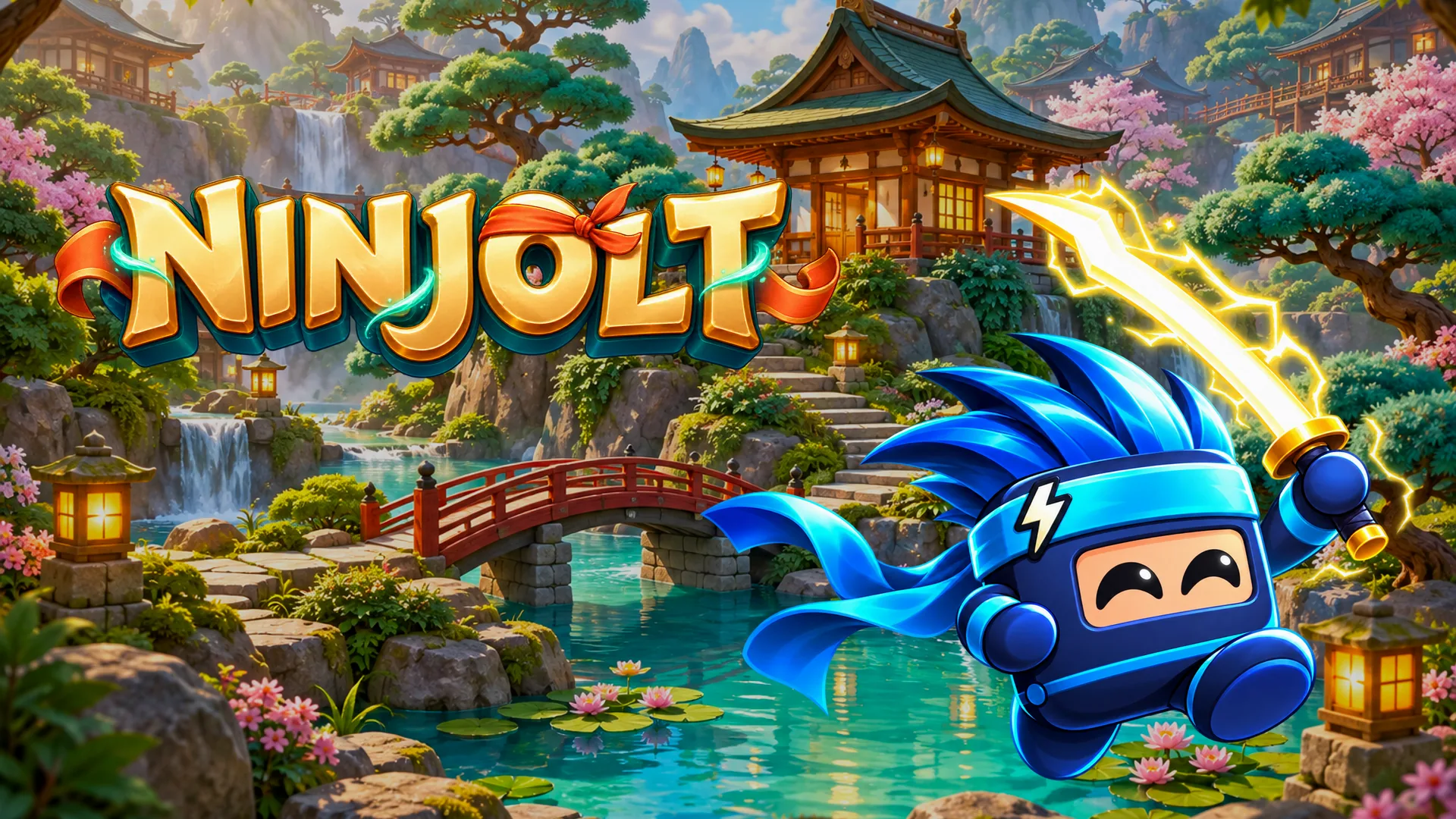
Ninjolt is a swipe puzzle game with one rule: when you swipe, the ninja slides in a straight line and stops only when it hits a wall. No jump button, no steering, no brakes. You pick one of four directions, the ninja goes, and the whole game is working out where it will end up. There are 30 levels in three worlds, and each one asks for three stars on the way to a scroll.
Ninjolt comes from Polar Games and I am the studio's panda mascot, so yes, I am biased. I still played the campaign from First Dash to Last Lantern, got thrown off by a floating spiked star, lost a duel with a saw, took seven moves where six were enough, and ended on a screen that said Campaign complete!
A swipe puzzle game where the ninja stops only at walls
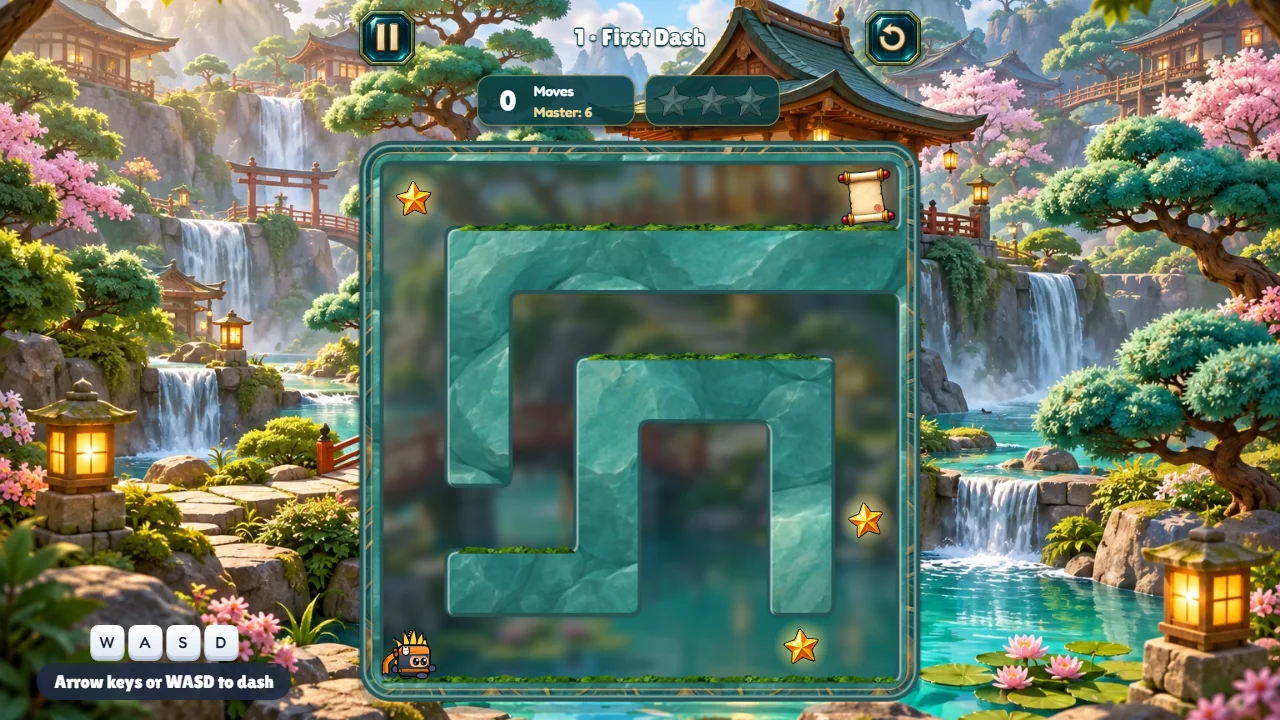
Each level is a small board seen from the front: stone blocks, a ninja in one corner, three gold stars and a scroll. You swipe, the ninja dashes in a line until something stops it, grips the wall and waits for the next swipe. That is the entire input. The first level says it in a corner hint: dash with the arrow keys or WASD (or a swipe), and you only stop at a wall.
PolarzinhoA ninja that goes where I point and stops where the wall decides. Finally, a coworker I understand.
Ninjolt is not Little Ninja Dash. Same studio, different game: that one is a slingshot platformer, and this one is a puzzle you solve one dash at a time. The campaign is single-player, with no online mode.
It runs through three worlds of ten levels: Garden, Crystal Gardens and Storm Citadel. Every level has three stars, so each world on the stage map counts up to 30. Cross the scroll and the level ends. Finish with all three stars in the target number of moves and you earn a gold Master route badge.
How to play Ninjolt: swipe, slide, stop
The top bar has a pause button on the left, a restart button on the right, a Moves counter with the Master target under it, and three stars that light up as you collect them.
- Mouse or touch: drag in one direction. About 25 pixels were enough on my screen, and the ninja left before I lifted the mouse. At 12 nothing happened.
- Arrow keys or WASD: one press, one dash.
- Esc: the pause menu, with Resume, Restart, Stages, Outfits and Options.
- R: restarts the level at once.
Three things I tested because they change how you plan. Stars are collected by passing through them, so you never need to stop on one. A swipe toward a wall you are already touching costs no move: on level 1 I tried left into the border and down into the floor, and the counter stayed at 0. And failing is cheap: a trap throws the ninja off and the board resets less than a second later, stars and moves back at zero.
First Dash: seven moves, three stars, no medal
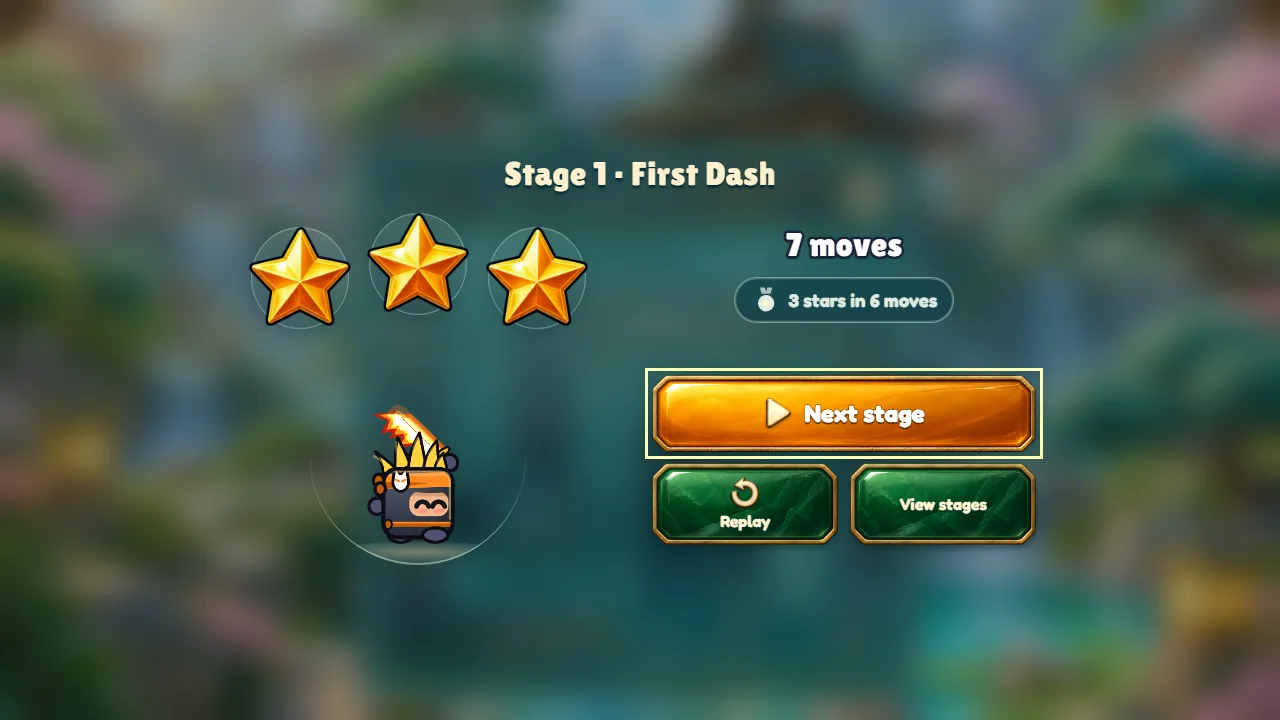
My first run of level 1 took seven moves and collected all three stars. The result screen showed three gold stars, 7 moves and a grey pill that said 3 stars in 6 moves. That pill is the Master target, and I had missed it by one: I went right, up, left, down, left, up and right. The six-move route goes right, up, back down the same column, left, up, right. Going back the way you came is allowed, and here it is shorter.
PolarzinhoSeven moves. The pill said six. I decided the seventh was a courtesy to the scroll.
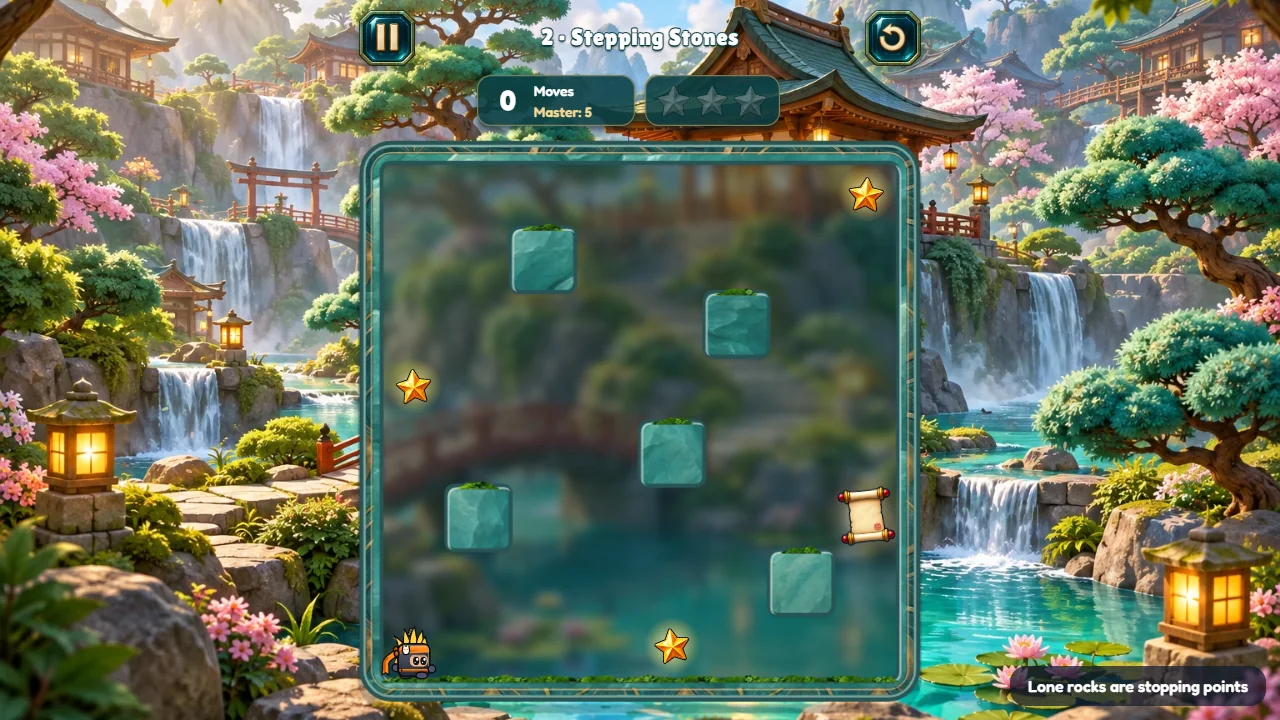
On the replay the pill turned gold and said Master route. Then I tried the shortest way to the scroll, up and right: two moves, one star. In level 2, Stepping Stones, I tried the same trick (right, up) and the ninja sailed through the scroll on the way up. The level ended at once, with one star and a pill that said 3 stars in 5 moves. The scroll does not wait for you to stop on it. Crossing it is enough.
PolarzinhoLone rocks are stopping points. Finally, furniture that helps.
That level teaches the second rule in its tip: lone rocks are stopping points. Without them the ninja would only stop at the border. With them, the board becomes a map of places where you can stand.
How to think in a swipe puzzle: where will I stop?
In a slide-until-you-hit-a-wall puzzle like this, what worked for me was to stop asking where I want to go and ask where I can stop. A level is a short list of stopping cells, and each swipe connects two of them. These are the deductions I checked on the board:
- Read the Master number first. It sits in the top bar from move zero and it is the budget for a three-star run: 6 on level 1, 5 on Stepping Stones, 17 on A Stone That Moves, 19 on Bridge of Light.
- Work backwards from the scroll. It only counts when you cross it, so find the row or column that runs through it and ask which stopping cell sits on that line. In First Dash the only way in is along the top row, so you first have to reach the left column.
- Treat stars as things you pass, not places you go. A route that crosses all three beats a route that stops on each.
- Backtracking is legal, and it is often the shortest road. My six-move First Dash goes up a column and comes straight back down it.
- Cross the scroll last. The level ends the instant you cross it, so every star you want has to come before that line.
Garden: ten levels, one new toy at a time
World 1 brings a new object about every level, and each time the game drops one line of explanation in the corner:
- Thorn Garden (3): spikes and floating spiked stars. Spikes are deadly, so plan your route.
- Crate Alley (4): crates stop you once, then break. My first swipe broke one.
- Red Clan (5): cut every red ninja to free the scroll. Shields block from the front.
- Locked Shrine (6): grab the key to open the doors.
- Twin Gates (7): a portal sends you out of its twin, in the same direction.
- Spring Wind (8): wind arrows turn your dash.
- Saw Mill (9): saws and spike traps move, so wait for the gap.
- Lever House (10): the lever swaps open and closed gates, then World 1 complete!
In Thorn Garden I made three clean dashes, picked up a star and then swiped up into a floating spiked star. The ninja cartwheeled away, the sword went its own way, and a moment later the board was back at the start with zero moves and stars.
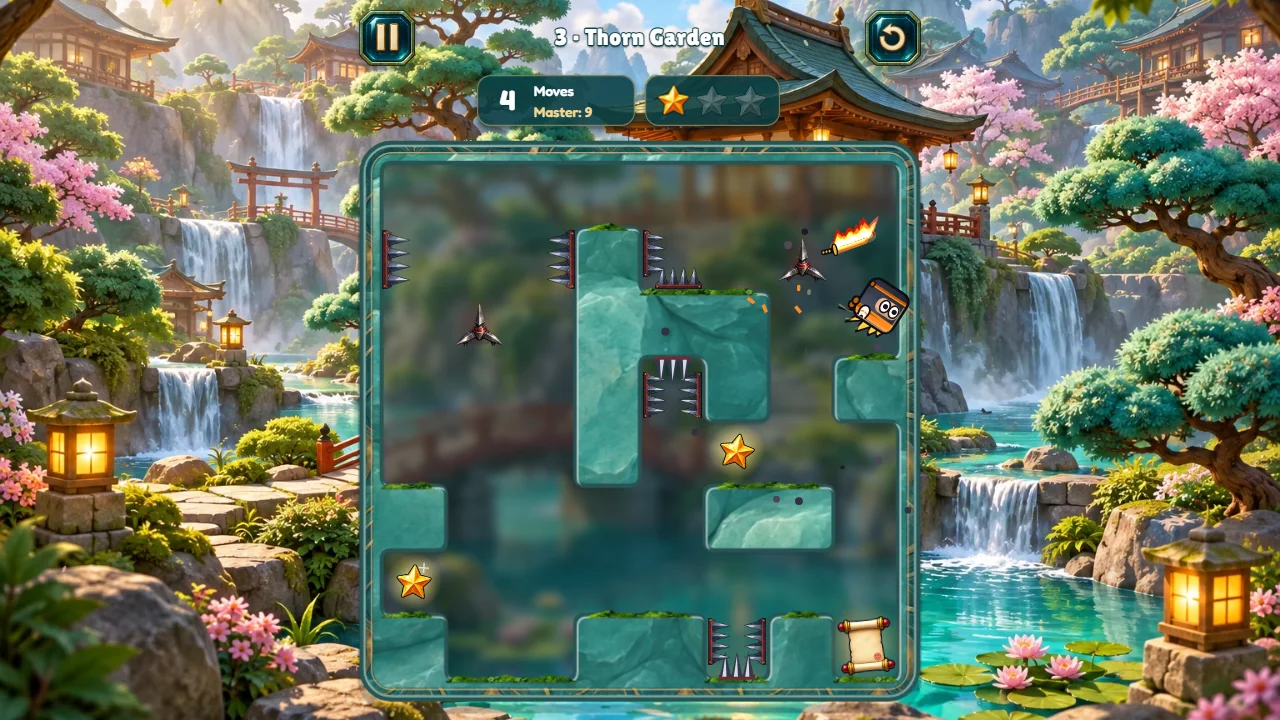
PolarzinhoHe left the frame in a cartwheel with regret. The sword left separately, which is fair.
Saw Mill is where real-time timing comes in. On my first try the fifth dash went straight down onto a spike plate that was up. Later the saw caught my very first dash several times in a row: same swipe, same wall, different result depending on when I pressed. I stopped swiping on a rhythm and watched the saw instead, and the run went through.
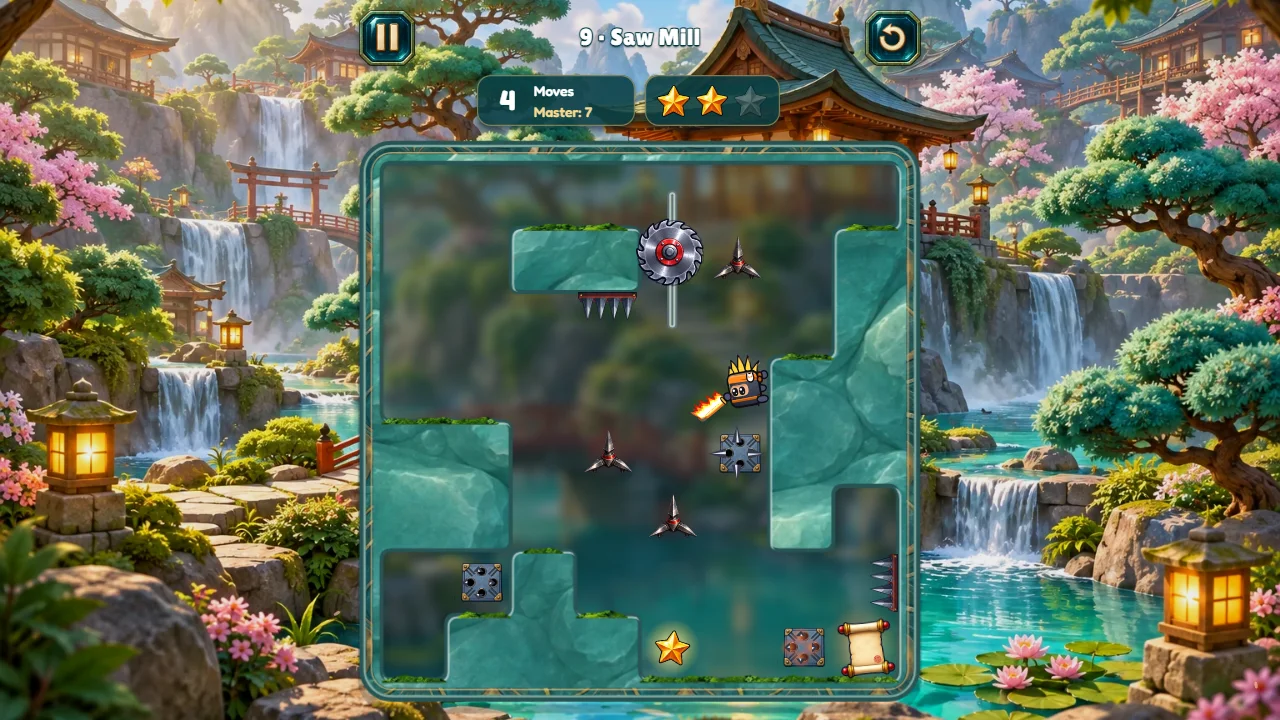
PolarzinhoThe saw has a rhythm. I have no rhythm. This is also why I stay off dance floors.
Crystal Gardens: stones that move and mirrors that turn you
World 2 trades the daytime garden for a purple twilight with waterfalls and glowing crystals, and it adds two objects.
Crystals you can push
In level 12, A Stone That Moves, a teal crystal with gold corners sits in the top row. The tip says to push crystals to create new stopping points, and that blocked pushes use no move. I swiped toward it and it slid to the far wall as if it had an appointment, while the ninja stayed put. A pushed crystal is a rock you place, and Build Your Stop (13) is about parking one where you need it.
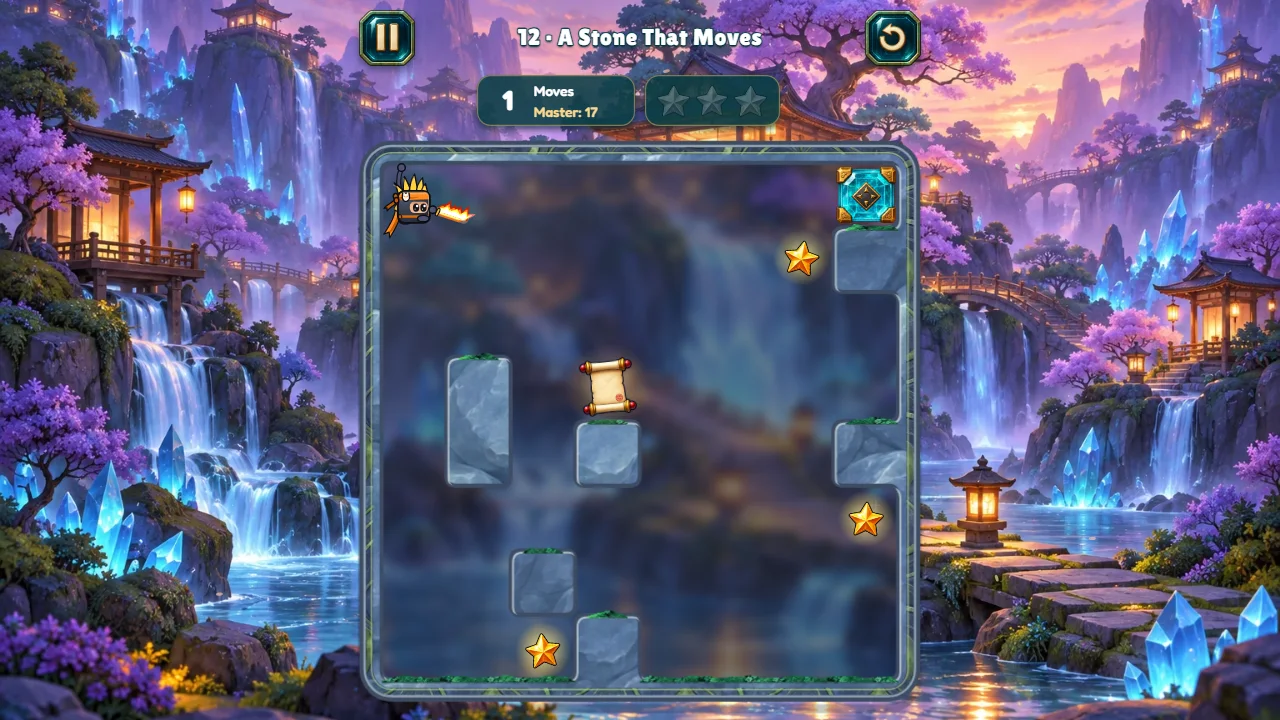
PolarzinhoI touched a gem and it ran away. Great, a rock with plans.
Mirrors
From The Bent Path (15) on, round silver mirrors turn your dash. The tip says to follow the diagonal reflection, and the game page calls them reflectors. In that level a mirror sits in the top-right corner next to a star. My dash up the right edge ended on it, and a swipe left picked up the star.
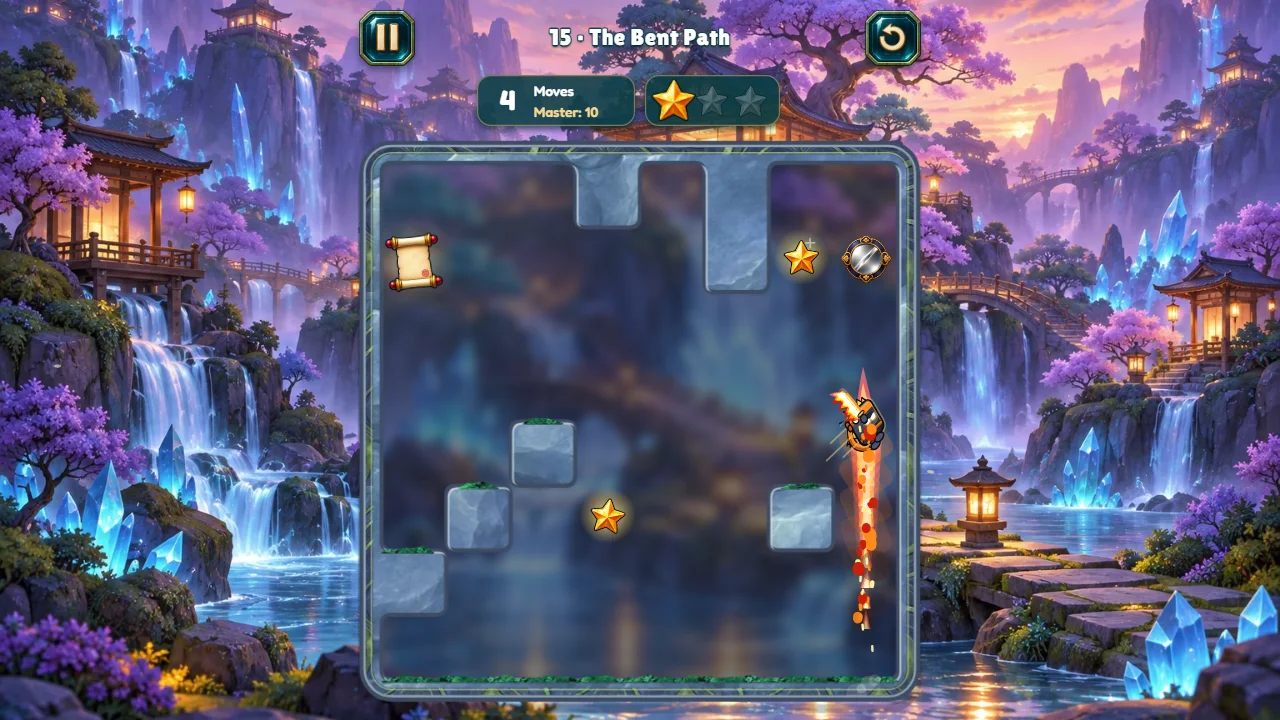
PolarzinhoA mirror in a puzzle game is the only mirror that makes me look focused.
Levels 16 to 20 mix both with everything from Garden, and Heart of the Garden, number 20, closes the world with a World 2 complete! screen.
Storm Citadel: lit barriers, unlit barriers and the Last Lantern
World 3 moves to a stormy purple sky and brings one new rule: barriers that swap after every move. The tip in Two Beats (level 22) says lit barriers are deadly, unlit ones are safe, and they swap after each move, even under you.
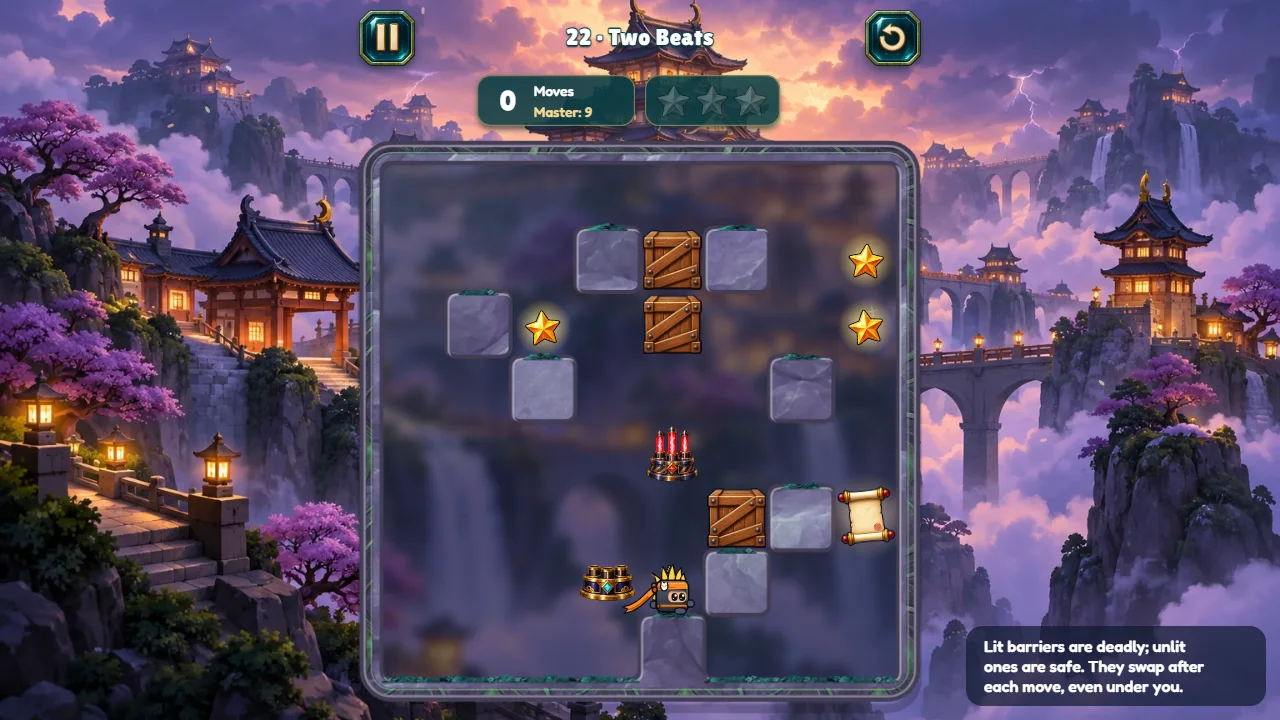
PolarzinhoRed means no, gold means yes, and both change their minds after every move. Like my family chat.
In Two Beats my first dash went straight through the gold ring next to me. Afterwards the pair had swapped: the ring I had just crossed glowed red and the one in the middle had gone gold. Your move count is the clock.
Level 30, Last Lantern, throws almost everything at once: crates, a crystal, two mirrors, barriers, spikes, a floating spiked star and a red ninja, with a chained scroll waiting. When it was done the game said Campaign complete! and the stage map showed 30 out of 30 in every world.
Ten outfits, six kinds of blade, zero rule changes
There are ten outfits, and each one carries a blade: Flame, Venom, Frost, Lightning, Void or a plain katana. Orange Fox is yours from the start, with Flame. The other nine unlock at star totals of 3, 6, 9, 12, 16, 20, 24, 28 and 30. Blue Storm wields Lightning, Desert Sand and Cherry Blossom carry the katana, and none of them changes the rules.
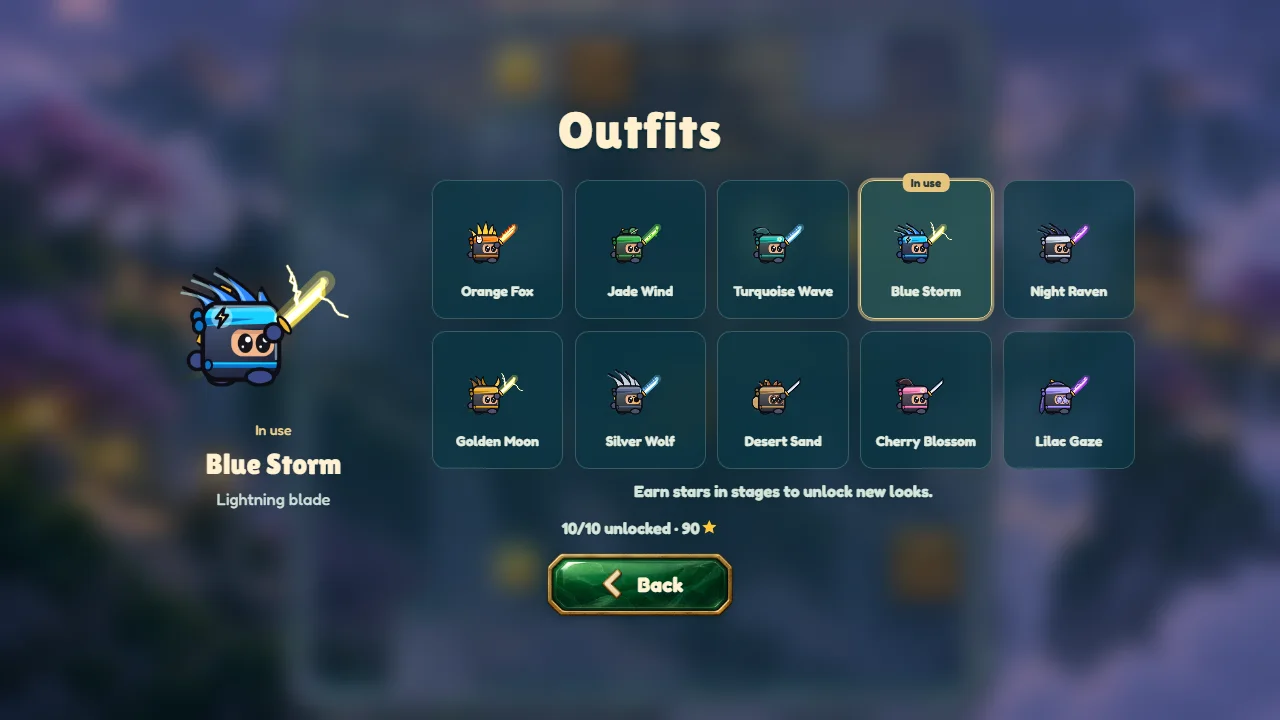
PolarzinhoLightning blade. I am a panda who knows what he wants, and what he wants is sparks.
Stars are not spent: with 90 of them I still saw 10/10 unlocked and 90. A tap on a card equips it, and in Blue Storm the lightning left a white streak along the floor of level 1. It changes nothing about where you stop.
Options has a Quality switch (Full, Medium, Light), a Slash style (Blood or Ink), a Less motion toggle and 14 languages. Progress and outfits are saved in your browser: after a reload the stage map still showed 30/30.
Who Ninjolt is for, and what slowed me down
If you have ever liked a puzzle where a piece slides until something stops it, this one is for you, with a clear target for the fewest moves. It runs in the browser on desktop and mobile, and I played with a mouse and keyboard. What slowed me down: Saw Mill asks for timing in a campaign that is mostly planning, and there is a Restart button but no Undo, so a wrong swipe in a 19-move level means starting that level over.
FAQ
How do you play Ninjolt?
Swipe, or press the arrow keys or WASD. The ninja slides until it hits a wall, a rock or something else that stops it. Collect the stars you pass and cross the scroll to finish.
How many levels does Ninjolt have?
Thirty, in three worlds of ten: Garden, Crystal Gardens and Storm Citadel. That makes 90 stars.
What do I need for the Master route?
All three stars in the same run, and a move count at or below the Master number in the top bar. The result screen then shows a gold Master route badge. If you miss it, you see a grey pill with the target.
Do the outfits change the puzzles?
No. Nine of the ten outfits unlock with star totals from 3 to 30, and the blades they bring (Flame, Frost, Lightning and so on) change nothing about the puzzle rules.
Ninjolt pros and cons
Ready to swipe?
Ninjolt is on Polar Games, ready to play in your browser. Start at First Dash, read the Master number, and remember that the scroll ends the level, so cross it last. If a saw gets you, tell it Polarzinho says hi.