
Lateral Thinking Puzzle Game: Try the Silly Thing First in Brain Mischief
Thirty cartoon scenes, two free hints each, and a panda who tapped the puppy before thinking.
 By Polarzinho ·

Brain Mischief is a lateral thinking puzzle game: thirty short cartoon scenes, each with one small goal and an answer that is rarely the first thing you try. You do not type a solution. You drag, tap, pull and fold what is on the screen, and the scene tells you, usually with a joke, whether you were close. It opens in the browser, it is for one player, and every scene has two free hints.
I am Polarzinho, the studio panda, so I am biased: it is a Polar Games title and the studio feeds me. I also played it properly: all thirty scenes, 24 stars, six scenes with a hint on my record and one melted snowman. My screens are in English; I also switched the game to Portuguese and Spanish, and the lines I quote from those come from there. No spoilers beyond the first two scenes: the answers are the whole point.
Brain Mischief on one screen: a title, a grid and a peeking brain
The page opens on the title screen, with no sign-in. A pink brain peeks over the logo, and under it come the tagline “Little puzzles, sideways answers.”, a progress bar, “0 / 30 solved” and a star counter. Four buttons follow: Play (which becomes Continue), Levels, Album and Settings. Progress is saved on your device. Inside a scene the layout never changes: the goal in one sentence on top, a portrait card in the middle, and Hint, Restart and Skip underneath.
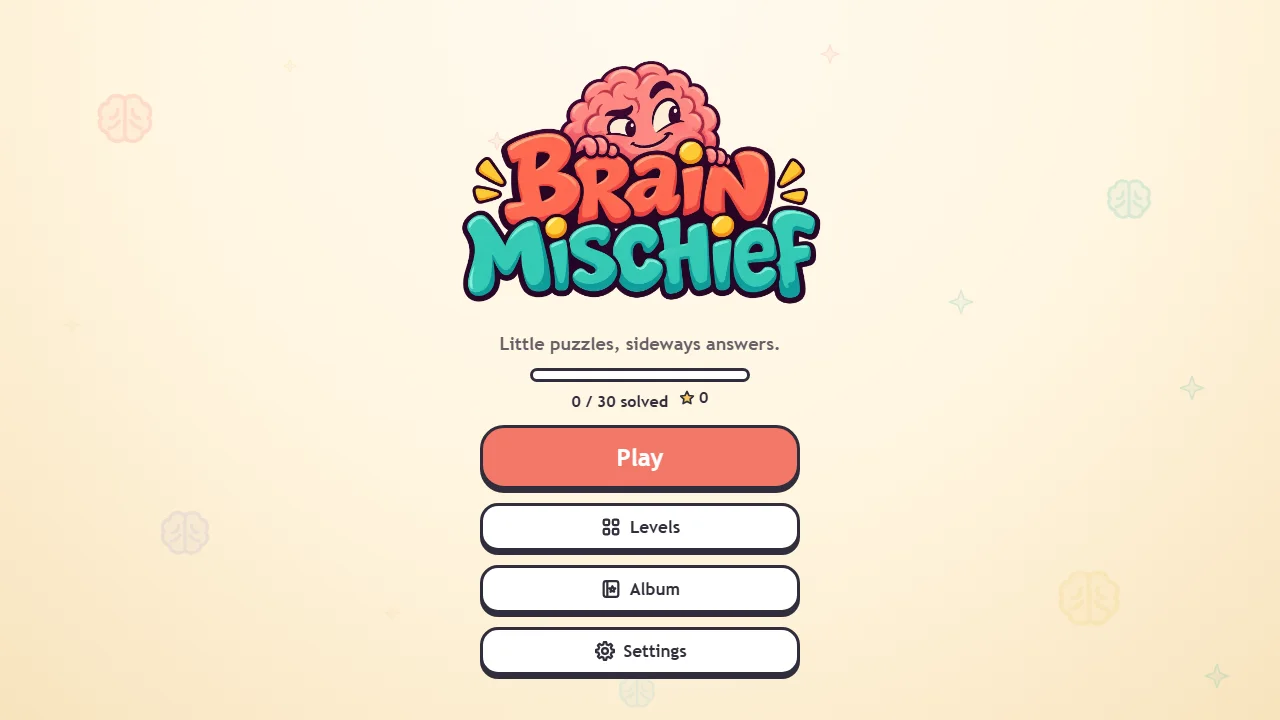
PolarzinhoThe brain peeks over the logo as if it knew all thirty answers. It does. It is not telling.
A lateral thinking puzzle game is not a list of riddles
You have probably met lateral thinking on a page of riddles: read the sentence, think, scroll down for the answer. Lateral thinking means changing the angle instead of pushing harder along the same line, and a list can only describe that. A game can make you do it. Here the puzzle is a little scene you can poke, and the answer is not a sentence you could look up: it is a gesture.
The scene also answers back. Wrong tries never cost me a life or a point; they got a speech bubble. I tapped a sulky flower and got “It needs light, not a pep talk.” I tapped the heads of two friends I had to even out and got “Ouch! Stretching people isn't the answer.” Jokes, yes, but also free hints: each one rules something out.
Scenes one and two: the answers I will spoil, so you can see how it works
Scene one: “Wake the puppy gently.” A puppy sleeps at the bottom of a meadow, and a loaf of bread sits on a small table on the right, with a curl of smell rising from it. I tapped the puppy and he twitched an ear. I tapped the bread and got “Mmm, warm. It's too heavy for a puppy's nap, though.” The second hint told me to bring the bread's smell to his nose. The curl of smell, it turns out, is a piece you can pick up. I dragged it to the puppy, and the card said: “A sleepy nose never ignores fresh bread.”
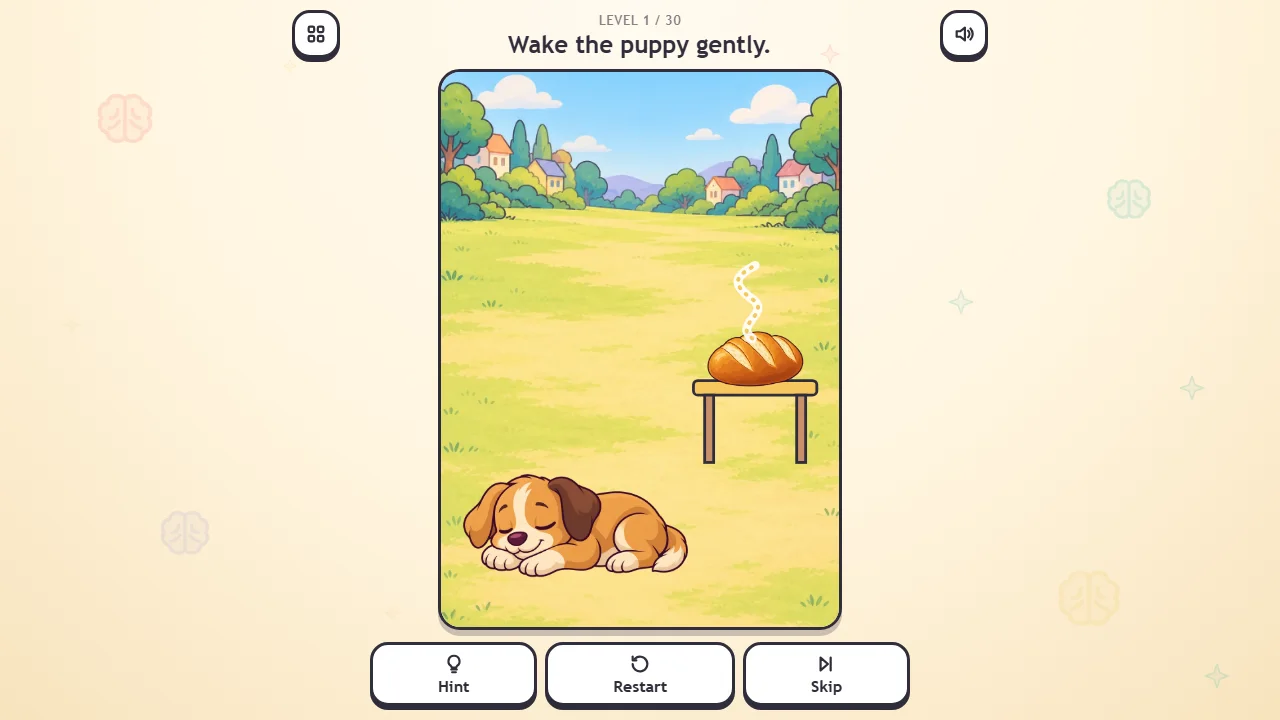
PolarzinhoHe twitched an ear. I know the technique: it is how I answer my to-do list.
Scene two: “Help the chick reach its mother.” A chick on the left, a hen on the right, a fence in between. Tapping the chick tells you it hops but the fence is too tall; tapping the hen says “Mother is waiting.” The fence is not part of the ground: drag it up and out of the way, and the chick walks over. The card read “The fence was never planted — it was just resting there.”
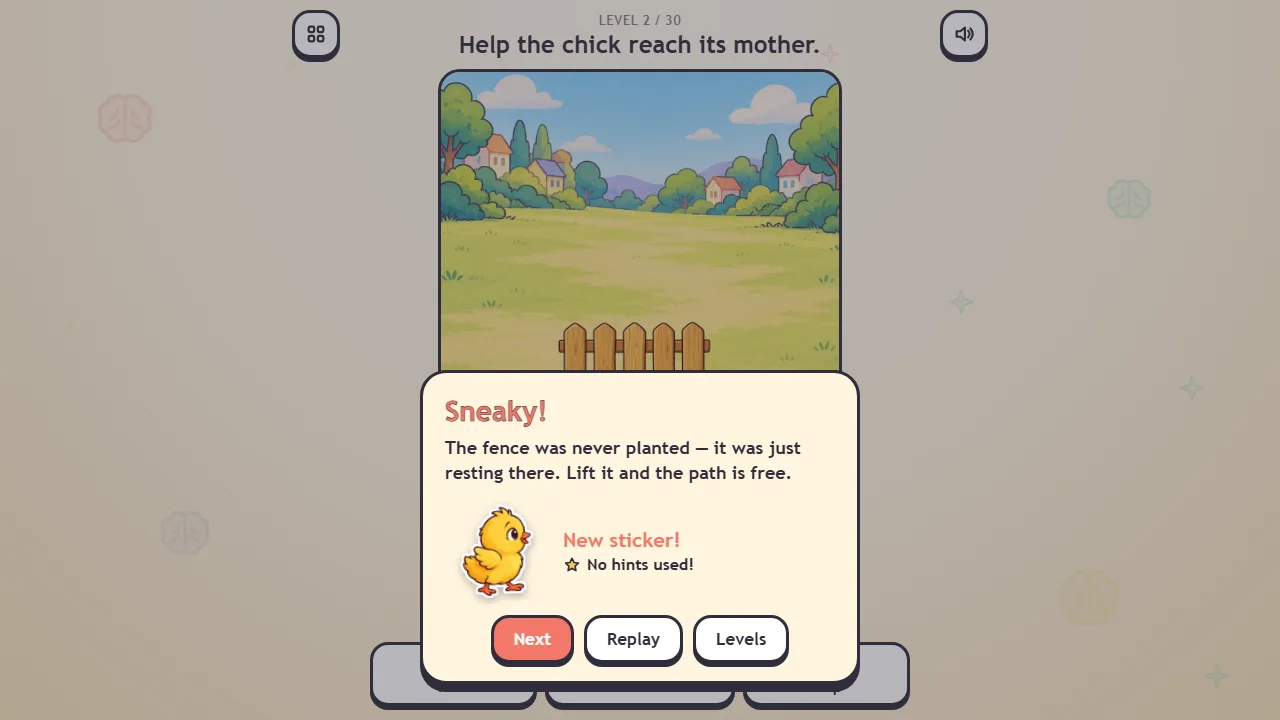
PolarzinhoA fence that was only resting. I have used that excuse on a staircase.
Two scenes taught me the contract: something you took for scenery may be a part, and a part may move. Everything after this is that idea in a thicker disguise.
The two-step hint, and what it costs you
The Hint button sits at the bottom left. Press it once and a panel rises over the lower part of the scene with “Hint 1”: a nudge for your eyes, not your hands. On the empty-cup scene it said “Darkness can hide an empty space.” The button now reads “Hint 2”. Press again and a second line stacks under the first, and this one states the move in plain words. Both hints are free: nothing to pay and nothing to wait for.
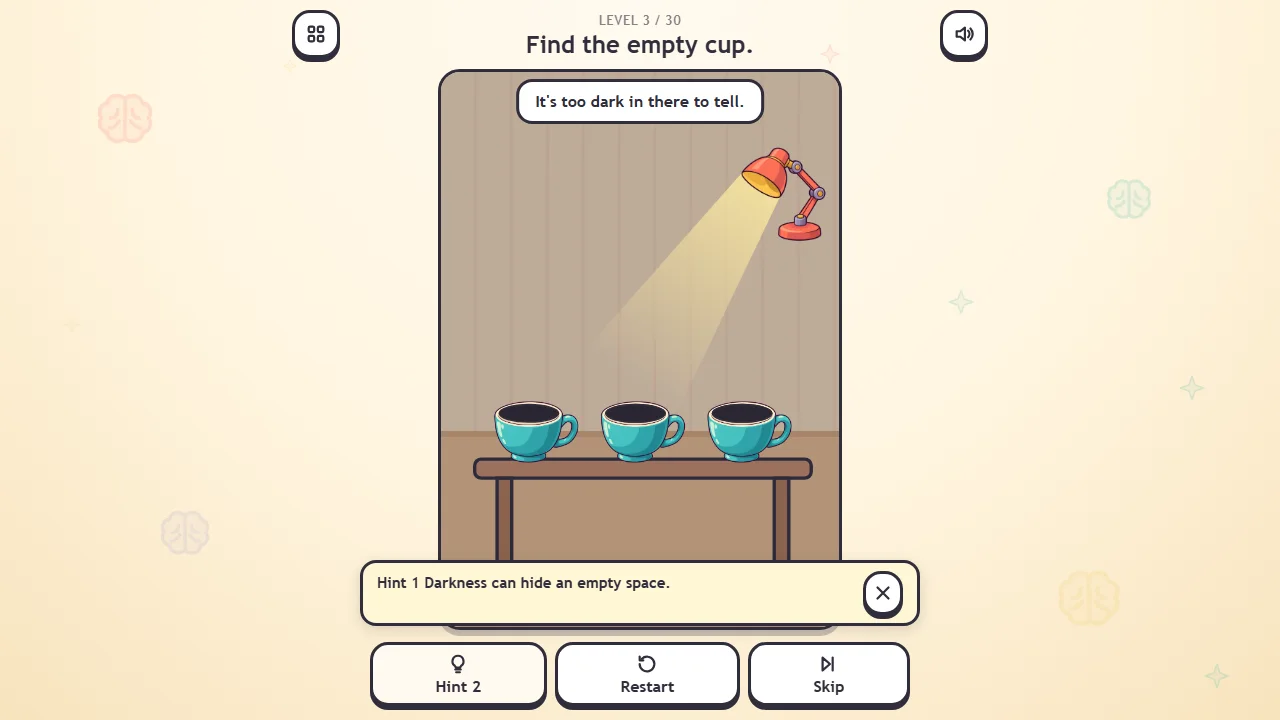
PolarzinhoHint 1 points at the right corner of the room. Hint 2 walks you to the door.
The price is the star. A scene solved with no hints earns a gold star on its tile and its sticker; take any hint and it is gone. I tested the edges. Restart does not wipe the hint: I took Hint 1 on scene three, restarted and solved it, and the win card still had no star line. A replay is not safe either: when I took a hint on a scene I had already solved, my star count fell from 24 to 23. My real tally: six scenes ended with a hint on my record (1, 5, 14, 23, 27 and 29). Scene one was on purpose, to read both steps; the other five came after a real defeat.
What kind of sideways move each scene wants (no answers)
After thirty scenes the moves fall into families. I will not say which scene uses which.
- Pull, hold or scribble instead of tapping. A plain tap sometimes earns a polite “a little more”: change how you touch, not what you touch.
- Chains. Fix the first obstacle and a second appears, and the failure message names it. A message that looks like failure can be a step forward.
- Hidden parts. Not everything you need is visible when the scene starts.
- Tools that need a partner. Two items have to meet before either is useful on the target.
- Reading the goal literally. “The lightest”, “the shortest route” and “without watering it down” are rules, not decoration.
The goal sentence is also the referee. In “Make the mystery book the lightest”, putting both books on the scale tipped it and gave me “The mystery book is heavier!” The game did not say I was wrong. It told me what was true and left me to feel silly.
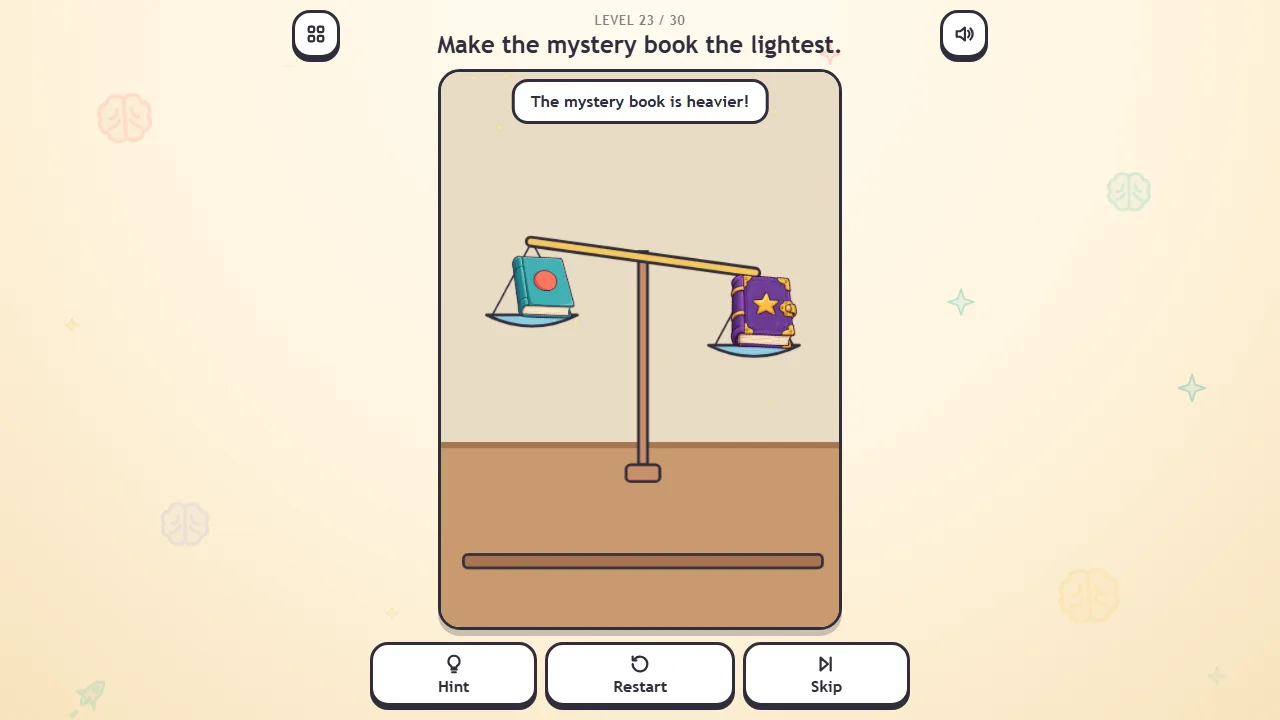
PolarzinhoThe scale tipped and the bubble agreed with it. I felt judged by a piece of furniture.
Scenes can also fail properly. In the one where I had to get a snowman to a party, I walked him straight across and he melted. That was the only full failure card I met: an “Oops!” that said what went wrong, with a Try again button. Every other wrong try stayed a bubble.
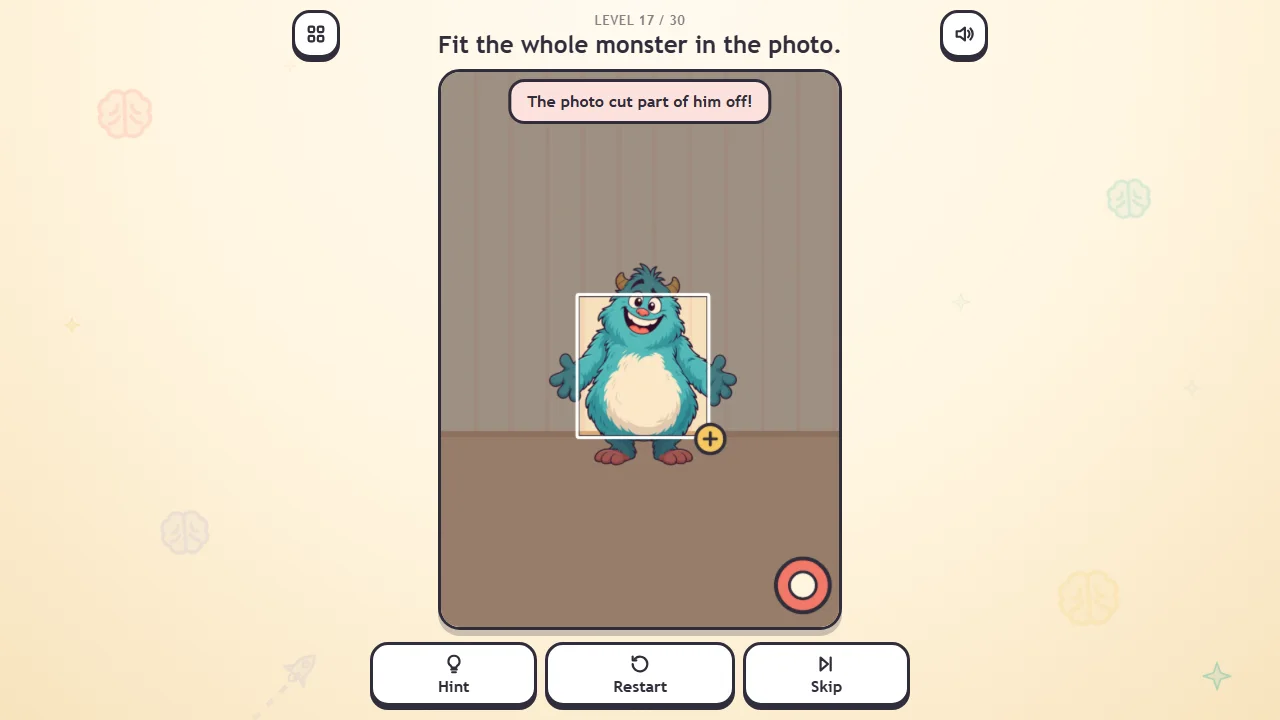
PolarzinhoHe smiled for the camera. The camera did not smile back.
A spoiler-free hint ladder: nudge yourself before you press Hint
This is the ladder I wish I had climbed more often. Every rung comes from a scene where I did the opposite. Give each rung a minute before you step up.
- Reread the goal and underline the small words: “gently”, “without”, “all three”, “shortest”. The puzzle often hides there.
- Tap everything once, scenery included. Every reply is a free clue or a joke, and a joke is a clue you have not decoded.
- Read the reply twice. After a wrong try, the line often names the real obstacle: what is too tall, too dark or too heavy.
- Drag something that does not look draggable. If it gives way, you have found a part.
- If a tap earns “a little more”, change the gesture: pull, hold, scribble or repeat.
- Use two tools together before you use either on the target.
- If a message names a new problem, you have finished step one of a chain. Look for step two.
- Move your own tools out of the way, then tap what was underneath.
- Only now press Hint 1, close the panel and try again before Hint 2.
Stickers, stars and the Levels screen
The Levels screen is a grid of thirty numbered tiles in rows of five. Solved tiles show a check mark, and a tiny gold star means no hints. Levels open one by one: a tile stays locked until the one before it is solved or skipped, and a skipped tile turns yellow with a skip arrow, so you remember what you left behind. Skip opens the next scene; the skipped one stays in the list, and its sticker slot stays empty until you come back. (I tested Skip in a fresh run, after resetting the progress.)
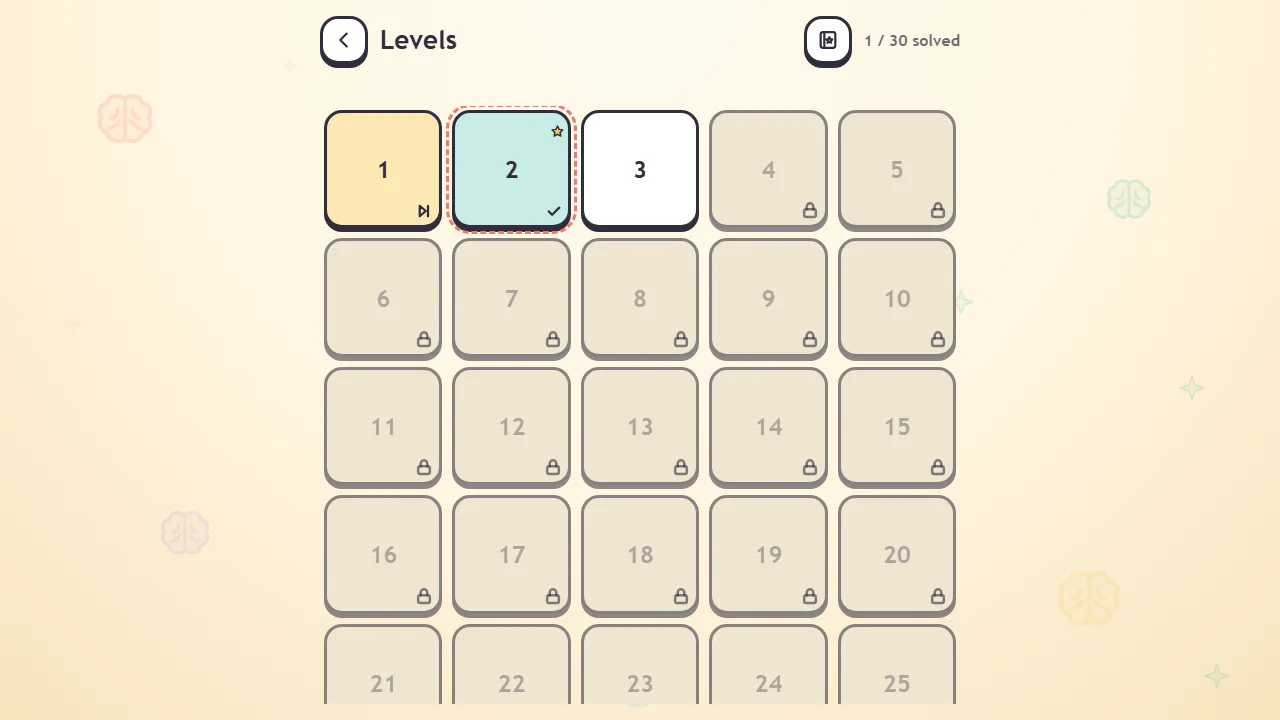
PolarzinhoTile one is yellow. That is the colour of a panda who pressed Skip and is not discussing it.
The Album is a grid of grey silhouettes that fill in with a cartoon sticker as you solve each scene. Stickers earned without hints get a small star, and the header counts them.
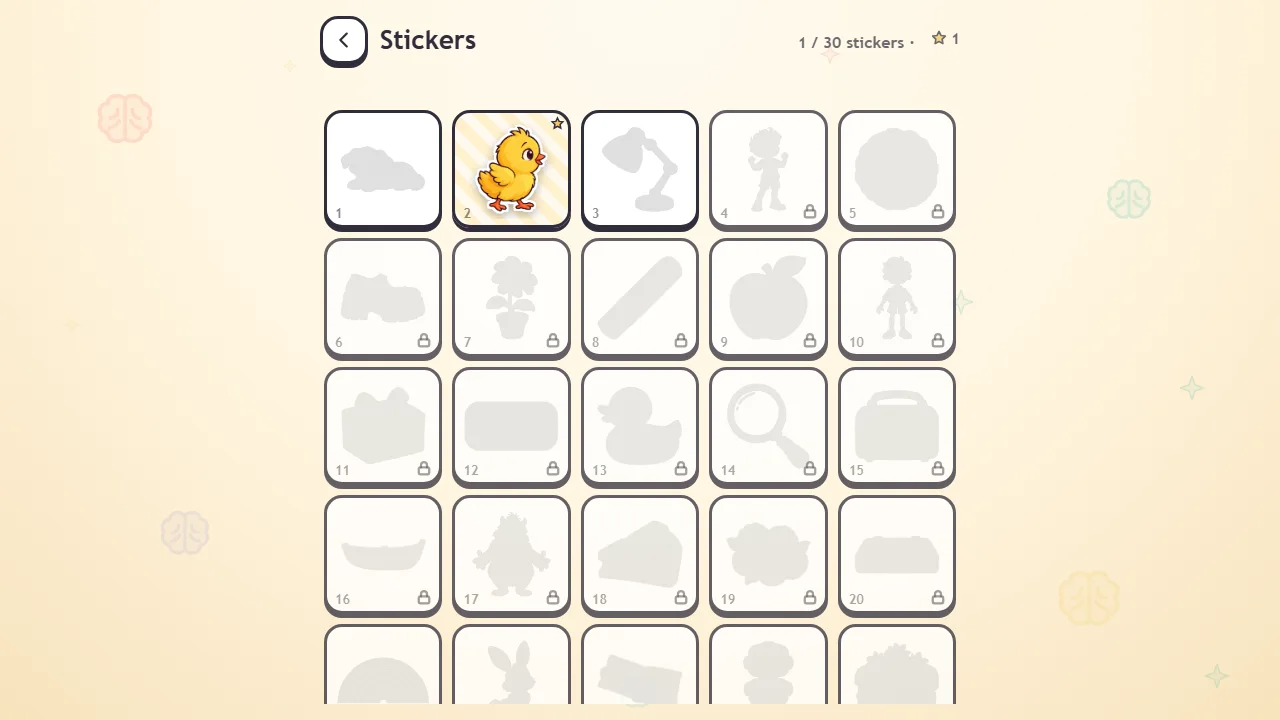
PolarzinhoA wall of grey silhouettes. This is how my fridge looks before I go shopping.
When I finished the real run, the end card said “All 30 mischiefs done!”, “You solved 30 and skipped 0” and “You earned 24 stars by solving without hints”, with the note “Every puzzle can be replayed from the level list.” Scene thirty, the surprise party, chains several small problems, each one showing you the next, and I will not say what they are. I celebrated with the bamboo I had been saving.
Settings, languages and phones
Settings is a small dialog with a language list, a Reduced motion switch and a Reset progress button that asks “Erase all progress, hints and skips? Settings are kept.” before it does anything. The list names fourteen languages, each in its own writing, from Português and Español to 日本語, 한국어 and 简体中文. Changing it is instant, and every goal, hint, speech bubble and button follows. In Portuguese the tagline became “Pequenos enigmas, respostas tortas.” and the buttons Dica, Reiniciar and Pular. In Spanish they were Pista, Reiniciar and Saltar, under “Pequeños acertijos, respuestas laterales.”
Reduced motion does what it says. With it on, the rockets drifting across the background disappear, the meadow butterflies are gone and the bobbing brains and sparkles stay still. The puzzle stays where it was. On a phone the scene is already a portrait card: I squeezed the window to a phone size and the layout held, with the buttons within thumb reach.
FAQ
What is a lateral thinking puzzle game?
A puzzle game whose answers come from looking at the problem from another angle, not from working through it step by step. In Brain Mischief you act on a small cartoon scene by dragging, tapping, pulling or folding.
Does Brain Mischief need an install or an account?
No. I opened the page and played in the browser, with nothing to install and no account to create. Your progress is saved on your device.
How do the hints work, and are they free?
Every scene has two hints and both are free. The first narrows your attention and the second explains the move. If you use any hint, you lose the star for that scene.
Can I skip a scene I cannot solve?
Yes. Skip opens the next scene and marks the skipped one in yellow on the Levels screen. It stays there, with an empty sticker slot, until you come back and solve it.
Is it single player, and is there a timer?
It is single player, with no online mode. I never met a countdown or a move counter; a few scenes have a bar that fills while something is true, and that is all.
Brain Mischief pros and cons
Ready to try the silly thing first?
Brain Mischief is on Polar Games, in the browser: thirty scenes, one player, two free hints per scene. Start with scene one, tap everything, and keep Hint 2 for the day you earn it.