
Button football rules explained: how touches, fouls and goals work
How the real table game works, from the flicking tool to the goalkeeper, and how Golazo! turns it into an arcade game.
 By Polarzinho ·
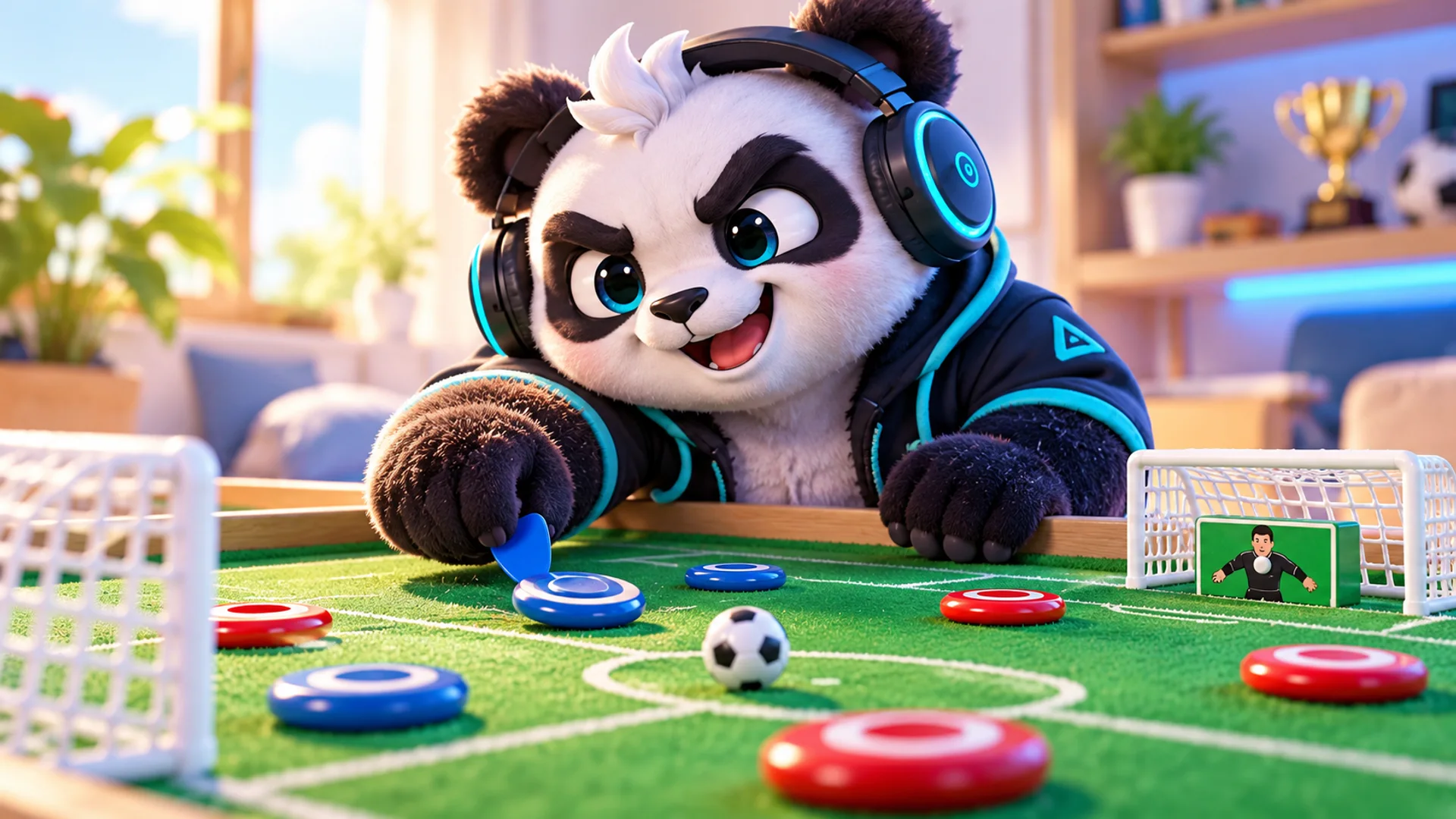
Button football rules in one breath: two players take turns pressing round pieces with a small flat tool so they slide into a tiny ball, and whoever scores more goals wins. The touches, the goalkeeper and the fouls are where the real game, and the real arguments, begin.
I am Polarzinho, the studio's panda mascot, so I am biased toward Golazo!, our own button football game (you will also see the sport called button soccer). Before I get to it, I read the official rulebook of the Brazilian table football confederation, checked it against Wikipedia and wrote down only what is actually in there.
Button football rules: the pieces, the goalkeeper and the table
I read the 12 Touches rule, which Wikipedia lists first among the main rule systems and which the CBFM (the Brazilian Table Football Confederation) publishes in English as well as Portuguese. According to the 2025 edition of that rulebook, a match has two players. Whoever has more goals at the end wins, and equal goals are a draw. Each side needs:
- Pieces: 10 round buttons plus 1 goalkeeper per player. A match cannot start with fewer than 10 buttons.
- Buttons: discs between 35 and 60 mm across, usually acrylic or a similar material.
- Goalkeeper: a smooth rectangular block, 80 by 35 by 15 mm and no heavier than 60 g.
- Ball: a sphere 10 mm across.
- Table: ideally 1.83 m by 1.20 m, with a 1.67 m by 1.04 m playing field.
- Goals: 125 mm wide and 50 mm tall on the inside.
How a piece moves: the palheta
You never flick a button with your finger. According to the CBFM, the player uses a flat tool (palheta in Portuguese, puck in the English edition of the rulebook), placed on top of the button and pressed against the table so the button slides. Direct contact of the hand with the button is banned, fingernails included.
That push is a touch, also called an activation. You have up to 5 seconds between touches, and the ball must be still when you make one. A touch only counts if the button moves. If your piece moves but fails to move the ball, it is a drill (furada in Portuguese) and the ball goes to your opponent. Wikipedia describes the same method: a flat disc pressed onto the piece so it slides forward.
Touches and turns: 12, 3 or 1
This is where the rule sets split. According to Wikipedia, the main difference between systems is the number of touches per possession. The CBFM lists several official sets, among them:
- 12 Touches (formerly the Paulista rule): 20 minutes in two halves of 10. You get 12 collective touches while you have the ball, and each button can take at most 3 in a row. You must shoot before the touches run out, or the other player gets an indirect free kick where the ball stopped.
- 3 Touches (formerly the Carioca rule): 40 minutes in two halves of 20, with a 5-minute break. Three collective touches, and on the second you must pass to another button to earn the third. A shot is allowed only if the first touch of the sequence was made in the attacking half.
- 1 Touch (formerly the Baiana rule): the set organized for the longest time, says the CBFM, played with two kinds of buttons, Liso (smooth underneath) and Livre (hollowed underneath).
- Dadinho: the newest national rule, which swaps the ball for a small acrylic cube. Each button gets up to 3 touches in a row and each team up to 9.
Counting is part of the game: in the 12 Touches rulebook, the player making the move must count the touches aloud so the opponent can follow.
Shots, goalkeeper and goals
A shot is not just a hard touch. According to the CBFM rulebook, the attacker has to announce it with words such as "going for goal" or "shot", and name the button that will take it. Only the penalty needs no announcement. Once the shot is called, the defender has 5 seconds to set the goalkeeper in front of the goal and say it is ready, and then the attacker has 5 seconds to shoot.
A goal counts when the point where the ball touches the table crosses the goal line, so the whole ball does not need to be over it. A ball that enters the goal without an announced shot is not a goal: play restarts with a corner or a goal kick. An own goal counts for the other player.
The defender cannot cheat the shot either. If they blow on the ball or bump the table to slow it down, the goal is awarded to the attacker anyway.
Fouls and restarts
The classic foul is a piece that hits an opponent's piece before touching the ball. The CBFM rulebook punishes it with a free kick. Also fouls: touching the ball with a hand, clothing or the tool, blowing on the ball, and pressing your own pieces when the other player has the ball.
- Ball over a sideline: a throw-in for the player who did not touch it last, made by moving a piece from outside the field. You get three attempts to put the ball back in play.
- Ball over an end line: a goal kick for the defending side or a corner for the attacking side, depending on who touched it last.
- Foul inside the penalty area: a penalty, which the CBFM calls the "maximum penalty".
- Other fouls: a free kick, either direct (you may shoot straight at goal) or indirect (a goal cannot come from a single touch).
- A piece that fails to move the ball (a drill): the ball goes to the other player.
After a foul, the fouled player gets the full 12 touches back and may even play on. Wasting time, arguing with the referee or throwing a tool are technical fouls, punished with a free kick or even exclusion. A referee is optional under the rulebook, and a player may ask for one.
Rules change between federations, clubs and families
Everything above is the CBFM's 12 Touches rule. The same confederation lists other sets: 1 Touch and 3 Touches, Dadinho with its cube instead of a ball, international ones such as Sectorball, and Chapas, which the CBFM says began in Spain and is also played in Argentina, Bolivia, Chile, Peru, Colombia, Venezuela and Uruguay.
Wikipedia adds that the game has no standard English name and that it is popular in Brazil and in various European countries, Hungary, Georgia and Slovenia among them.
So when someone at the table says "that is not the rule", the right answer is "which one?". Pick a rule set before the first kick-off.
House rules for your own table (a suggestion, not an official rule)
Want to play tonight? Here is the starter set I would use. It is a suggestion that borrows the touch count and the called shot from the rulebook, not a federation rule. Change anything your table dislikes.
- Each side gets five buttons of the same size and one block as the goalkeeper. Two books or boxes make the goals, and any small, light ball will do if you both agree on it first.
- Press the pieces with a flat tool, such as a plastic lid, never with your fingers.
- Each turn is three touches. After the third, the turn passes to the other player.
- Call your shot before you take it. A goal nobody called does not count.
- Hit an opponent's piece before the ball and it is a foul: the other player restarts from where the ball is.
- Ball off the table: the player who did not touch it last puts it back from the edge.
- Play two halves of five minutes on a phone timer. Most goals win.
How Golazo! plays it: pull back, aim, release
Golazo! is our arcade take on button football, with its own rules and controls rather than a copy of the CBFM rulebook or any other federation's. It keeps round pieces, a ball, goals and turns, and swaps the flat tool for a slingshot motion: hold a piece, pull backwards to set direction and power, and release. You do it with the mouse on a computer or with your finger on a phone.
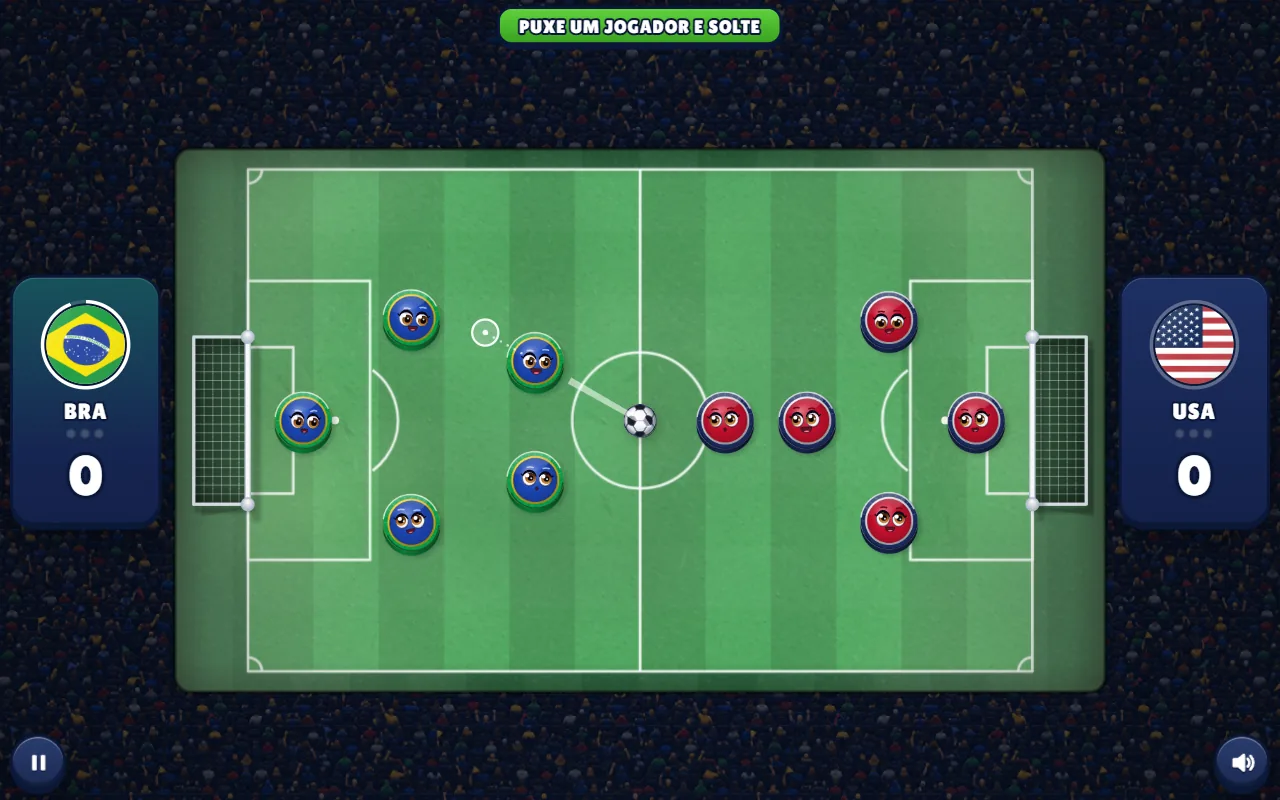
PolarzinhoPull, aim, let go. Three verbs, and I still find a way to miss.
Matches are turn-based. The game's own pitch is to use angles, bank shots and combinations to work the ball toward goal, and before kick-off you choose nations, difficulty, formation and match length.
Then there is Fire, which no federation rulebook has. Build your charge, activate Fire with the Fire button or the F key before your shot when it is ready, and aim a powered shot with flaming pieces. Esc pauses or resumes the match.
Golazo! modes: friendly, Cup, two players and guided practice
You can pick from 49 nations, and everything happens on the device in front of you:
- Friendly against the CPU.
- Cup: an eight-nation knockout bracket, from the quarterfinals to the final.
- Two players on one device: share the screen with a friend.
- Guided practice: it introduces aiming, power control and the Fire shot.
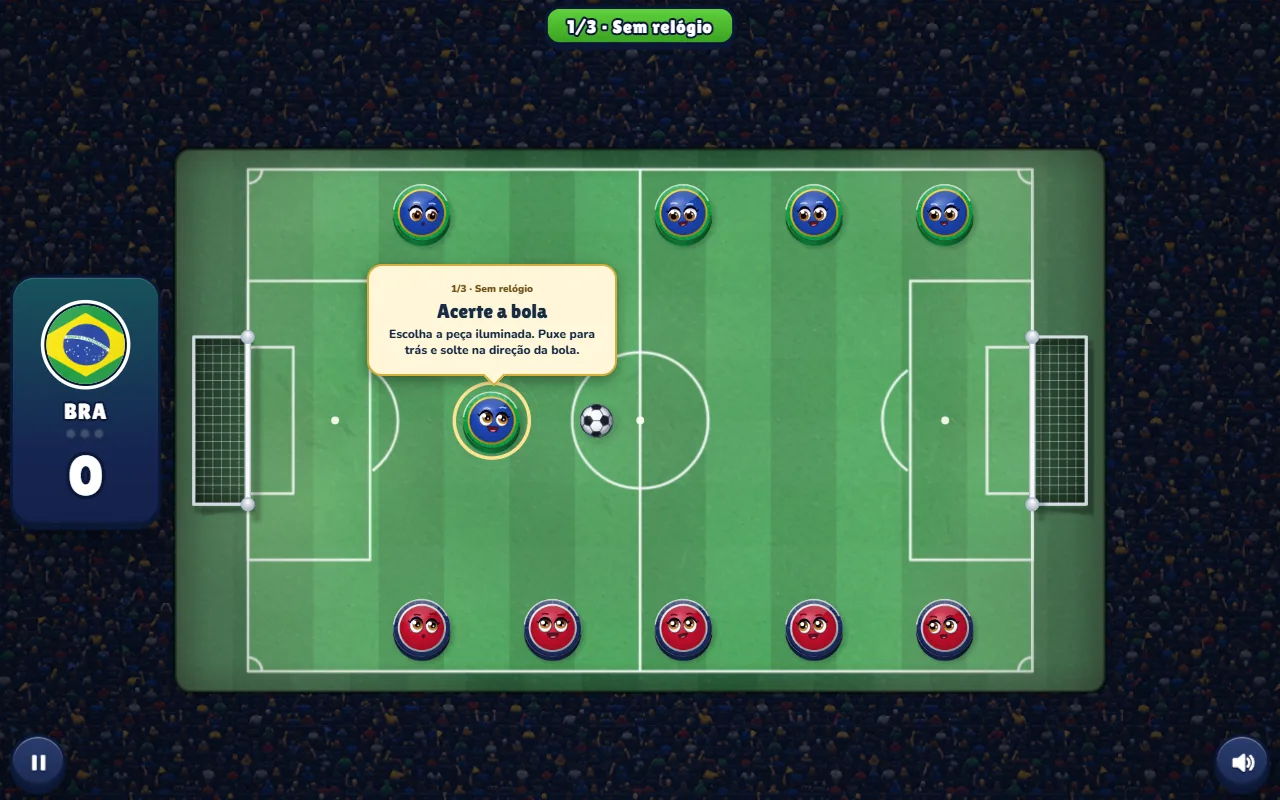
PolarzinhoStep one of three: hit the ball. Even I managed that, and my paws are bigger than a palheta.
Challenges, finishes and saved progress
The Cup album tracks challenges for each nation. Completing them unlocks cosmetic piece finishes, which change how your pieces look and never the rules. Challenges and unlocks are saved in the browser you play in. The interface comes in 14 languages, English, Portuguese and Spanish among them.
FAQ
How many touches do you get in button football?
It depends on the rule set. In the CBFM's 12 Touches rule you get 12 collective touches while you have the ball, with at most 3 in a row per button. In 3 Touches it is 3 collective touches, and in 1 Touch, one.
How do you score a goal in button football?
Announce the shot and name the button that will take it, let the other player set the goalkeeper, then shoot. If the point where the ball touches the table crosses the goal line, it is a goal. Without the announcement it does not count.
Can you use your fingers in button football?
Not under the CBFM rulebook: you use a flat tool, the palheta, and direct contact of the hand with the button is banned, fingernails included. At home, every family decides. In Golazo! there is no tool at all: you hold a piece, pull back and release.
How long is a button football match?
In the CBFM's 12 Touches rule, 20 minutes in two halves of 10. In 3 Touches, 40 minutes in two halves of 20, with a 5-minute break.
Does Golazo! follow the official button football rules?
No. It is an arcade version with its own controls and the Fire shot, which is not in the CBFM's 12 Touches rulebook.
Can two people play Golazo! together?
Yes, in the two-player mode on one device. You can also play a friendly against the CPU or an eight-nation Cup.
Your turn
Two paths: read the full CBFM rulebook, or just press play. In Golazo!, start with the guided practice and then try the Cup. At home, write the house rules down before the first kick-off, and remember to call your shot.