
Vertebrates and Invertebrates: Who Has a Backbone and Who Doesn't
Vertebrates and invertebrates made simple: the five vertebrate groups with examples, the main invertebrate groups, how to tell them apart and a quiz on the animal kingdom.
 By Polarzinho ·
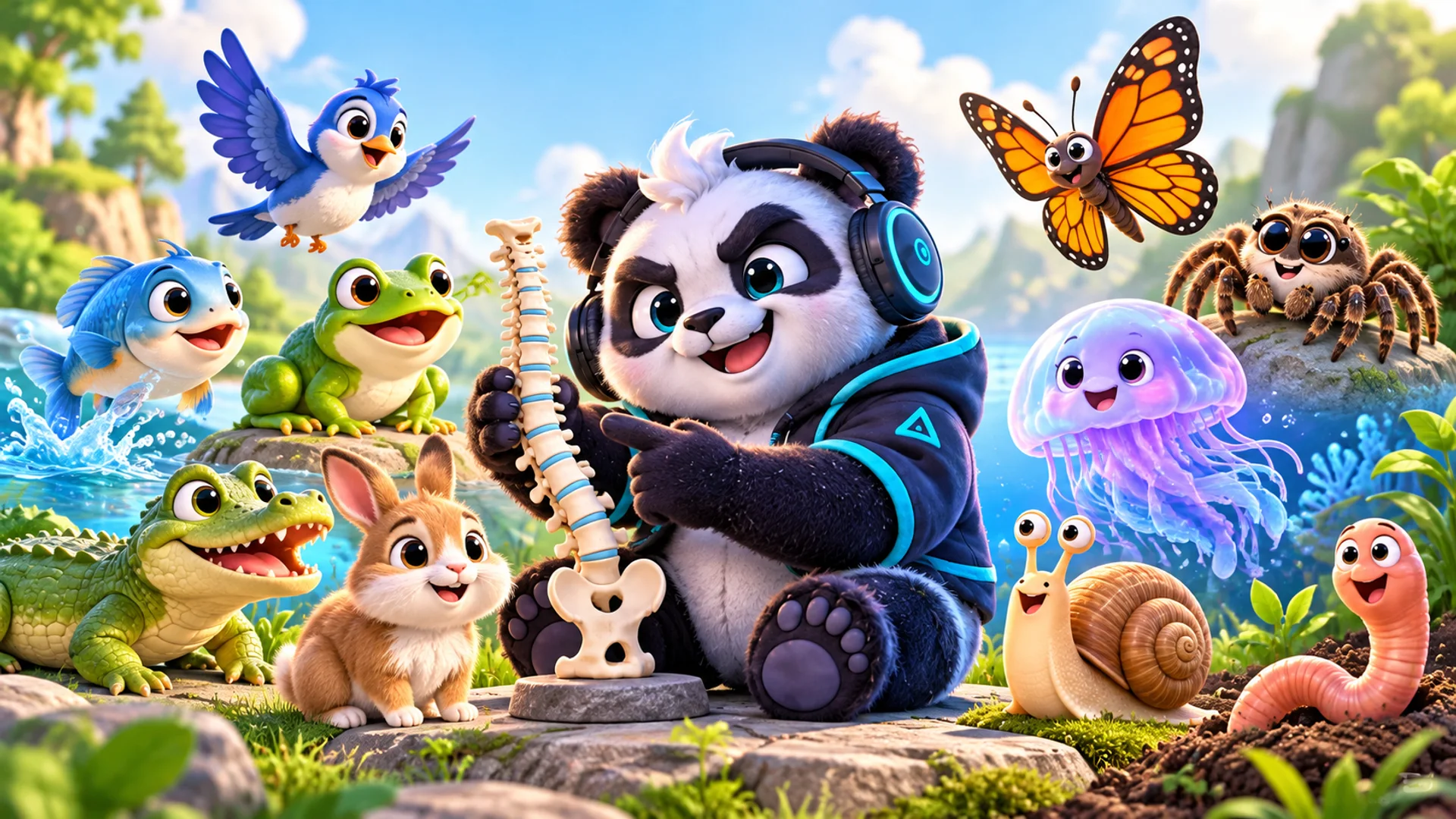
Vertebrates and invertebrates are the two big teams of the animal kingdom, and one part tells them apart: the backbone. If an animal has one, it is a vertebrate. If not, it is an invertebrate. I have one, and it complains when I play for a whole afternoon without standing up.
I am Polarzinho, the studio's panda mascot, and a panda is a mammal. Here you get the five vertebrate groups, the main invertebrate groups, a one-question test to tell the two apart, the most common mix-ups and a quiz with answers.
What are vertebrates and invertebrates?
A vertebrate is an animal with a backbone, the row of small bones called vertebrae that holds the body up and protects the spinal cord. An invertebrate is an animal without one. That puts a giraffe and a goldfish on the same team, the vertebrates, and an ant and a squid on the other.
Having a skeleton is not the same as having a backbone. A sea star has an internal skeleton of tiny limestone plates but no backbone, so it is an invertebrate. A shark has a skeleton made mostly of cartilage and is still a vertebrate.
One more detail few people mention: invertebrate is not a real group with a single ancestor. The word is only a convenience: it lumps together everything that is not a vertebrate.
The animal kingdom: where each one fits
The animal kingdom (Animalia) is made of living things with many cells that have to eat other living things, unlike plants, which make their own food. In school it shows up as one of the five kingdoms in Robert Whittaker's 1969 system: monera, protists, fungi, plants and animals. Scientists now use newer systems, but this one is still common in textbooks.
Not every animal looks like an animal. An adult sponge stays attached to one spot and has no true organs, yet it is an animal, and an invertebrate.
Most of the animal kingdom is invertebrate. By IUCN Red List counts from 2014, cited on Wikipedia, over 95% of described animal species were invertebrates. The number shifts as new species are described, but vertebrates stay a small slice.
The five groups of vertebrates
School teaches five: fish, amphibians, reptiles, birds and mammals. The same list appears in the Animal Diversity Web of the University of Michigan.
Fish
They live in water, breathe with gills and most have fins and scales. Most are cold-blooded, meaning body temperature follows the water (tuna and some sharks are exceptions). Examples: salmon, shark, clownfish, seahorse.
Amphibians
Thin, moist skin that helps them breathe. Most start life in water as tadpoles with gills and go through a metamorphosis into an air-breathing adult. Their eggs are jelly-coated and need water or very damp places. Examples: frog, toad, newt, salamander and the caecilian.
Reptiles
Dry skin with scales or plates, lungs and, mostly, shelled eggs laid on land. Some snakes and lizards give birth to live young. Examples: crocodile, sea turtle, python, gecko.
Birds
Feathers, a toothless beak, wings, hard-shelled eggs and warm blood. Most fly, but some lost flight, like penguins and ostriches. Examples: eagle, parrot, hummingbird, owl.
Mammals
Hair and mammary glands that feed the young with milk, plus warm blood. Nearly all are born from the mother's body, and the exceptions lay eggs (more on that below). Examples: tiger, whale, bat and you.
A note for science fans: scientists today say fish and reptiles are not each a single branch of the tree of life (birds, for example, descend from reptiles). The five-group split is the school version, and it works for getting started.
The main groups of invertebrates
There are many, and school covers the big ones. None has a backbone, but each holds itself up in its own way: a shell, a hard outer coat, little plates inside or just a body full of water.
- Sponges (poriferans): sea sponges.
- Cnidarians: jellyfish, corals and sea anemones, with stinging cells.
- Worms: three separate phyla (big groups), the flatworms (tapeworms), the roundworms (nematodes) and the annelids (earthworms and leeches).
- Mollusks: snail, slug, mussel, squid and octopus.
- Arthropods: insects, spiders and scorpions, crabs and shrimp, centipedes. They have jointed legs and a skeleton on the outside, the exoskeleton.
- Echinoderms: sea star, sea urchin and sea cucumber.
Arthropods run the show: insects are the most diverse group of animals.
An insect has six legs and three body parts: head, thorax and abdomen. A spider has eight legs, two body parts and no antennae. So a spider is not an insect, it is an arachnid. Both are invertebrates.
How to tell them apart: the four-question test
- Does it have a backbone? If not, it is an invertebrate and you can stop here.
- If yes, what covers the body? Scales, moist skin, feathers or hair.
- How does it breathe? Gills in water, lungs in air, and amphibians also use their skin.
- How is it born? From an egg with a shell, from a jelly-coated egg in water, or straight from the mother, who then feeds it milk.
Common mix-ups
A panda I know, Biscuit, swears a starfish is a fish because it has a star and lives in the sea. I respect the logic. Science does not. These are the traps most people fall into:
- Are worms and spiders vertebrates? No. An earthworm is an annelid with no backbone. A spider is not an insect either: it is an arachnid with eight legs. Both are invertebrates.
- Is a jellyfish a fish? No. It is a cnidarian with no backbone. A starfish is not a fish either: it is an echinoderm. Cuttlefish, crayfish and silverfish are no fish at all: a mollusk, a crustacean and an insect.
- A shark has no bones, so is it an invertebrate? No. Its skeleton is mostly cartilage, but it has a backbone and is a vertebrate.
- Are whales and dolphins fish? No. They are mammals: they breathe air with lungs and nurse their young. The whale shark is the opposite: a real fish.
- Is a caecilian a snake? No. It is a legless amphibian, often mistaken for a worm.
- Is a seahorse a fish? Yes, a bony fish, even with that chess-piece look.
- Are all fish one group? No: there are three, jawless fish (lampreys), cartilaginous fish (sharks and rays) and bony fish, the majority.
Three true fun facts
- The octopus is an invertebrate with three hearts: one pumps blood to the body and two send blood to the gills. Its blood is bluish, because oxygen travels on a copper-based protein, hemocyanin.
- In seahorses, the male is the one who gets pregnant: the female puts her eggs in a pouch on his belly, and he is the one who releases the babies. He has no scales, only bony plates under the skin.
- Only five species of mammals lay eggs: the platypus and four species of echidna. They still have hair and make milk.
Mini quiz: vertebrate or invertebrate?
Say whether it is a vertebrate or an invertebrate and, if it is a vertebrate, which group. The answers are right below.
- Shrimp
- Frog
- Penguin
- Shark
- Octopus
- Bat
- Jellyfish
Answers: 1, invertebrate (an arthropod, a crustacean). 2, vertebrate, amphibian. 3, vertebrate, bird. 4, vertebrate, fish (cartilaginous). 5, invertebrate (a mollusk). 6, vertebrate, mammal, the only one that truly flies. 7, invertebrate (a cnidarian).
Bird and fish on one screen: Tenguin
There is a famous vertebrate right here on the site: Tenguin the penguin, from Tenguin Number Match, a number puzzle that runs in the browser, on a computer or a phone. You clear the board by pairing equal numbers or two that add up to 10, and Tenguin teaches the rules, cheers you on and travels with you across a map of islands.
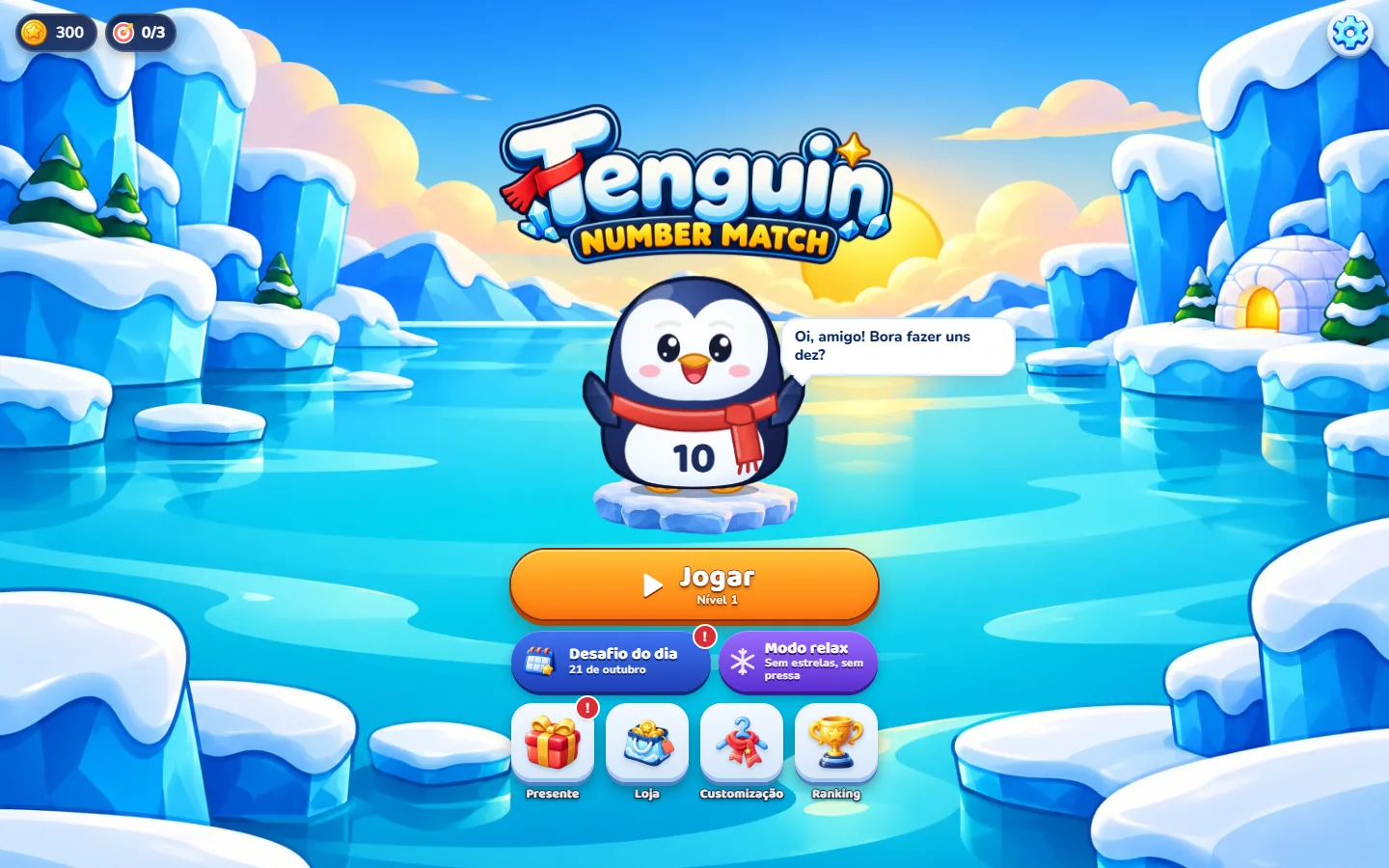
A penguin is a bird: it has feathers and a beak, lays eggs and is warm-blooded. It just does not fly, because its wings became flippers for swimming. Almost all penguins live in the Southern Hemisphere, and there are no penguins in the Arctic. Cartoons helped spread that idea. Yes, Tenguin's scenery has an igloo and snowy pines, but it is game scenery, and I refuse to be the panda who complains about an igloo.

PolarzinhoA bird and three fish on one screen: two of the five vertebrate groups without leaving the map.
It is a light connection: Tenguin is a number game, not a science game. But if you play with a kid, ask: is the penguin a fish? And what group is the jumping fish?
FAQ
What is the difference between vertebrates and invertebrates?
Vertebrates have a backbone and invertebrates do not. That is the only rule: size, color, number of legs or living in water do not change the classification.
What are the five groups of vertebrates?
Fish, amphibians, reptiles, birds and mammals. That is the split taught in school.
Is a jellyfish a vertebrate or an invertebrate?
An invertebrate. A jellyfish is a cnidarian: it has no backbone, no bones and no true brain, and it is not a fish either.
Is a spider an insect?
No. A spider is an arachnid, with eight legs and two body parts. An insect has six legs and three body parts. Both are invertebrates and arthropods.
What is the animal kingdom?
It is the group of many-celled living things that feed on other living things, and most move at some stage of life. It includes vertebrates and invertebrates, and invertebrates are the vast majority.
Are there more vertebrates or invertebrates?
Invertebrates, by far: by IUCN counts from 2014, they were over 95% of described animal species. And the most diverse group of all is the insects.
Your turn
Pick five animals you saw this week, from the street dog to the ant in the kitchen, and answer: backbone or not? If yes, which group? I would go with pigeon, gecko, snail, mosquito and cat.