
Types of Angles: Acute, Right, Obtuse and Straight
What an angle is, how to measure it with a protractor, the types of angles (zero, acute, right, obtuse, straight, reflex and full), complementary and supplementary angles and clock examples.
 By Polarzinho ·
In pool, whoever gets the angle right gets the pocket. I learned that by missing about thirty shots in a row. Once I understood the types of angles, the table got a lot friendlier.
Here you get what an angle is, how to measure one, the types with examples, angle pairs and a clock trick so you never mix them up again.
What is an angle?
An angle is the opening between two rays that start at the same point. That point is the vertex, and the rays are the sides of the angle.
Angles are measured in degrees (°). A full turn is 360°. You measure them with a protractor.
Types of angles
- Zero angle: 0°. Both sides lie on top of each other.
- Acute angle: more than 0° and less than 90°. A "narrow" angle.
- Right angle: exactly 90°. The corner of a sheet of paper.
- Obtuse angle: more than 90° and less than 180°. A "wide" angle.
- Straight angle: 180°. The sides make a straight line.
- Reflex angle: more than 180° and less than 360°.
- Full angle: 360°, one complete turn.
The clock trick
Clock hands make angles. Each number on the face is 30° from the next, because 360° ÷ 12 = 30°.
- 1 o'clock: 30°, an acute angle.
- 3 o'clock: 90°, a right angle.
- 4 o'clock: 120°, an obtuse angle.
- 6 o'clock: 180°, a straight angle.
Complementary, supplementary and vertical angles
- Complementary: two angles that add up to 90°. 35° and 55° are complementary.
- Supplementary: two angles that add up to 180°. 110° and 70° are supplementary.
- Vertical angles: when two lines cross, the angles facing each other are equal.
Angles in Velvet Pool
In Velvet Pool, the aim shows a dotted line to the contact point on the ball and the path that ball will take to the pocket. The gap between those two lines is the angle of the shot.
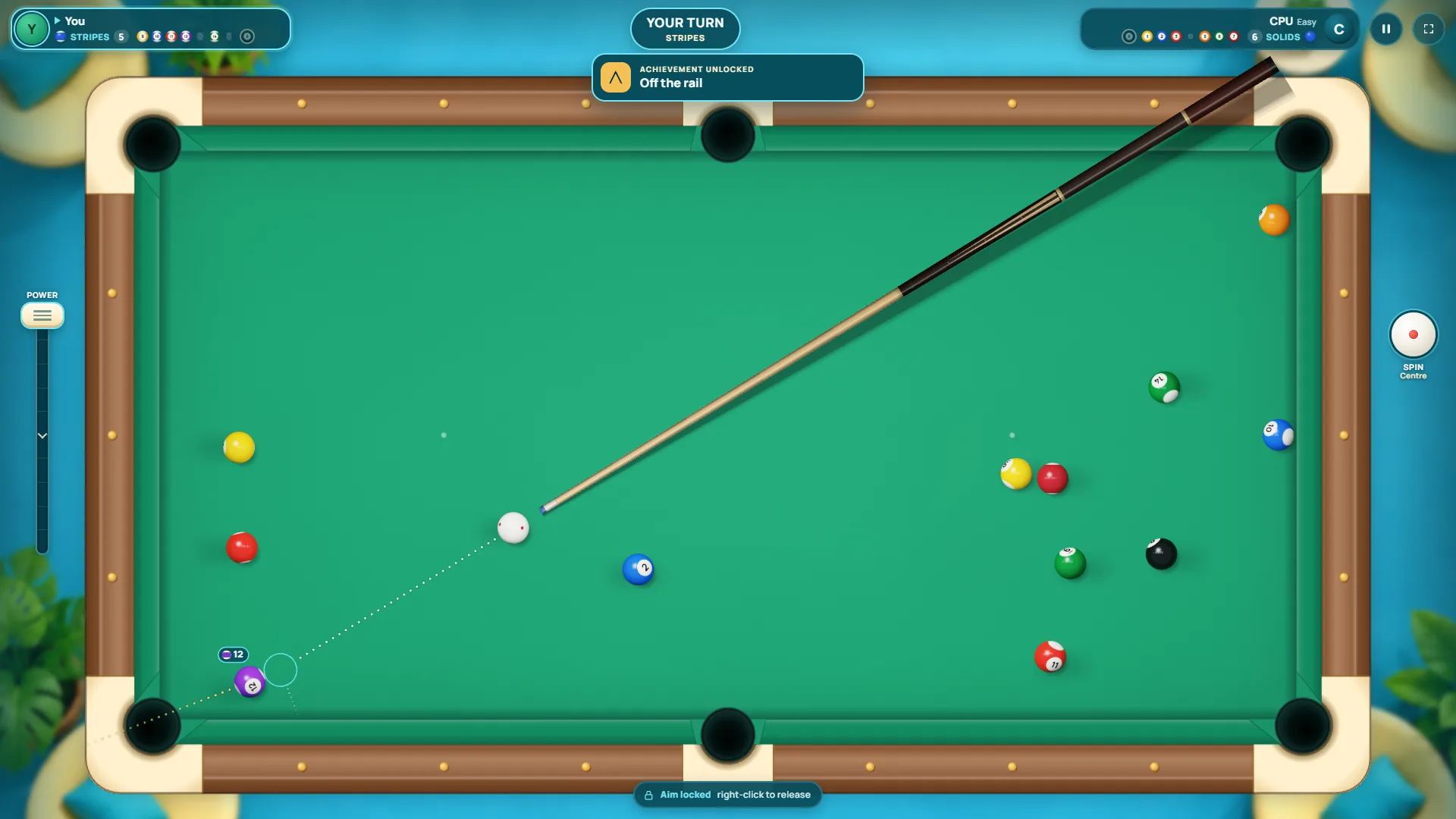
PolarzinhoAcute angle, ball in the pocket. Obtuse angle, ball on a sightseeing tour.
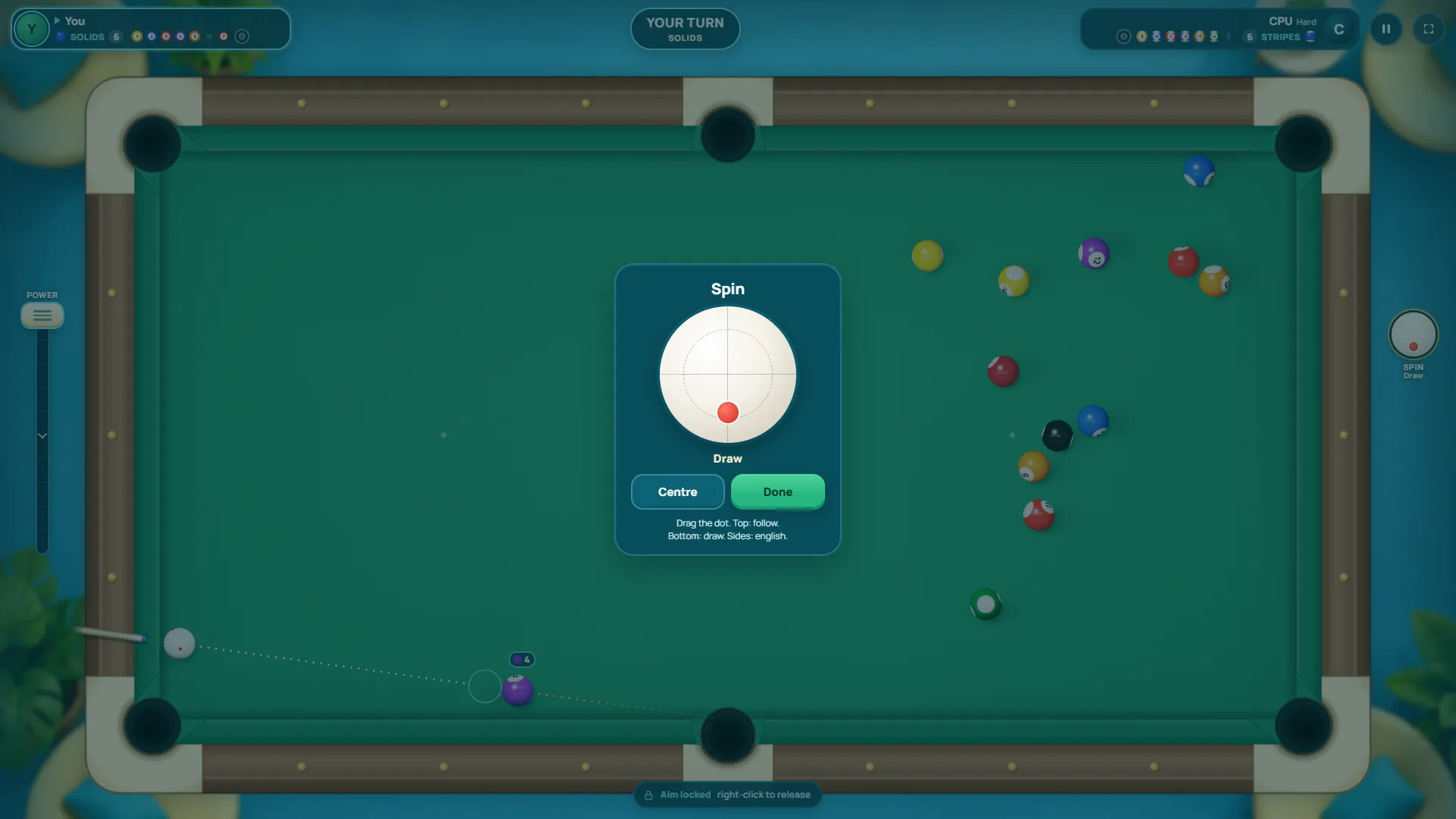
On a bank shot with no spin, the ball usually leaves the cushion at about the same angle it hit it. Spin changes that, and Velvet Pool has a whole panel for it.
FAQ
What is an acute angle?
An angle greater than 0° and less than 90°.
What is an obtuse angle?
An angle greater than 90° and less than 180°.
How many degrees is a right angle?
90°.
What is the difference between complementary and supplementary?
Complementary angles add up to 90°; supplementary angles add up to 180°.
Your turn
What type of angle do the clock hands make at 2 o'clock? At 5? Then find a right angle and an obtuse angle in your room.