
Prime Numbers 1 to 100: List and How to Find Them
What prime numbers are, the full list from 1 to 100, why 1 is not prime, the Sieve of Eratosthenes, divisibility tricks and fun facts about primes.
 By Polarzinho ·

My Twirldrop record is 53 floors. And 53 has a superpower: it divides evenly only by 1 and by itself. It is a prime number, and I think that is way cooler than the record.
Here you get what a prime number is, the list from 1 to 100, an easy way to check if a number is prime and a few fun facts that even cicadas know.
What is a prime number?
A prime number is a whole number greater than 1 with exactly two factors: 1 and itself. 7 is prime, because only 1 and 7 divide 7 with no remainder.
Numbers greater than 1 with more factors are called composite. 6 is composite, because 1, 2, 3 and 6 all divide 6.
List of prime numbers from 1 to 100
- 1 to 10: 2, 3, 5, 7
- 11 to 20: 11, 13, 17, 19
- 21 to 30: 23, 29
- 31 to 40: 31, 37
- 41 to 50: 41, 43, 47
- 51 to 60: 53, 59
- 61 to 70: 61, 67
- 71 to 80: 71, 73, 79
- 81 to 90: 83, 89
- 91 to 100: 97
There are 25 prime numbers between 1 and 100.
How to check if a number is prime
- If the number is even and bigger than 2, it is not prime.
- Add up the digits. If the sum is a multiple of 3, the number divides by 3. Example: 51, because 5 + 1 = 6.
- If it ends in 0 or 5 and is bigger than 5, it divides by 5.
- Try dividing by the primes 7, 11, 13 and so on, only up to the prime whose square is bigger than the number.
- If none of them divides evenly, the number is prime.
Example with 91: it is not even, 9 + 1 = 10 is not a multiple of 3, and it does not end in 0 or 5. But 91 ÷ 7 = 13. So 91 is not prime, even though it looks like one.
The Sieve of Eratosthenes
More than 2,000 years ago, the Greek thinker Eratosthenes came up with a way to find every prime up to a number:
- Write the numbers from 2 to 100.
- Circle 2 and cross out all its multiples.
- Circle the next number not crossed out, 3, and cross out its multiples.
- Repeat with 5 and 7.
- The numbers left uncrossed are the primes.
Prime factorization: every number is made of primes
Every number greater than 1 can be written as a product of primes in exactly one way. Example: 60 = 2 × 2 × 3 × 5 and 84 = 2 × 2 × 3 × 7.
That is why primes are called the building blocks of numbers.
Fun facts about prime numbers
- Primes never run out. The Greek mathematician Euclid proved it more than 2,000 years ago.
- Twin primes are pairs of primes 2 apart. Up to 100: 3 and 5; 5 and 7; 11 and 13; 17 and 19; 29 and 31; 41 and 43; 59 and 61; 71 and 73.
- Some periodical cicadas in the United States come out of the ground every 13 or 17 years, both prime numbers.
- Online shopping security relies on math with huge primes.
- The biggest known primes have tens of millions of digits and were found by computers.
A prime record in Twirldrop
In Twirldrop you spin a tower so the ball drops through the gaps, floor by floor. In the run in the picture, the screen shows 12 floors and a best of 53.
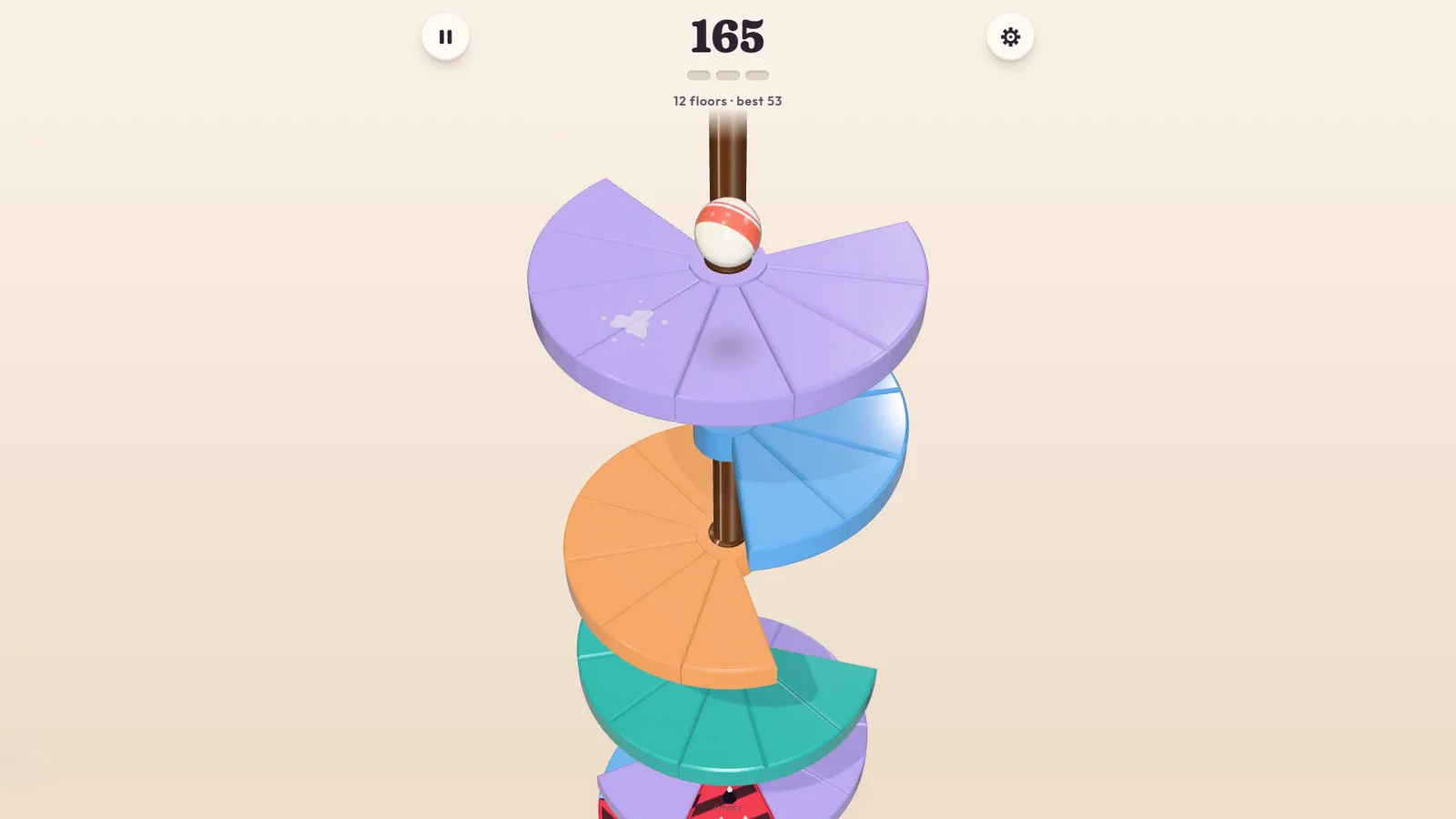
Polarzinho12 floors now, 53 as my best. 53 is prime. 12 is composite. I am an optimist.
Next prime after 53? 59. New goal unlocked.
FAQ
What are the prime numbers from 1 to 100?
2, 3, 5, 7, 11, 13, 17, 19, 23, 29, 31, 37, 41, 43, 47, 53, 59, 61, 67, 71, 73, 79, 83, 89, 97.
Is 1 a prime number?
No. A prime needs exactly two factors, and 1 has only one.
What is the only even prime number?
2.
How many prime numbers are there?
Infinitely many. Between 1 and 100 there are 25.
Your turn
Without the list: is 57 prime? What about 59? Hint: add up the digits of 57.