
How Do Magnets Work? Poles, Types and Fun Facts
What a magnet is, how it works, north and south poles, which metals are magnetic, the types of magnets, electromagnets and a homemade compass you can make.
 By Polarzinho ·

I spend hours sticking things on the fridge just to watch the magnet hold them. It looks like magic: it pulls without touching. But there is an explanation, and it is cooler than magic.
Here you will see what a magnet is, how it works, why poles attract or repel, which metals it pulls, the types of magnets and an experiment to try at home.
What is a magnet?
A magnet is an object that creates a magnetic field around it, an invisible force that attracts some metals and pushes or pulls other magnets. This property is called magnetism.
North pole and south pole
Every magnet has two poles: north and south. The rule is short:
- Opposite poles attract: north pulls south.
- Like poles repel: north pushes north, south pushes south.
Here is the fun part: if you break a magnet in half, you do not get a north piece and a south piece. Each piece becomes a new magnet with both poles.
How do magnets work?
Inside materials like iron there are tiny regions that act like mini magnets. In a plain piece of iron, they point every which way and cancel out. In a magnet, most of them point the same way, and their forces add up.
The magnetic field is invisible, but you can see it: sprinkle iron filings on paper over a magnet and they draw the field lines, leaving one pole and arriving at the other.
Why is a U-shaped magnet so strong?
In a U-shaped (horseshoe) magnet, both poles sit side by side, so the field is concentrated in the gap between them.
What metals are magnetic?
- Magnetic: iron, nickel, cobalt and most kinds of steel.
- Not magnetic: aluminum, copper, gold, silver, and also plastic, wood and glass.
Types of magnets
- Natural: magnetite, a rock that comes out of the ground already magnetized.
- Permanent man-made: built and magnetized on purpose, like ferrite magnets (fridge magnets) and very strong neodymium magnets.
- Temporary: an iron nail near a magnet becomes a magnet for a while, then loses it.
- Electromagnet: a wire coiled around an iron core. With electric current it is a magnet; switch it off and it stops.
Earth is a giant magnet
Our planet has a magnetic field. A compass needle is a small magnet that lines up with that field and points north. That is how sailors found their way for centuries.
Magnets in everyday life
- Fridge magnets and cabinet doors.
- Compasses.
- Speakers and headphones.
- Electric motors, from fans to electric cars.
- Scrapyard cranes that use electromagnets to lift scrap.
- MRI scans at the hospital.
Experiment: homemade compass
- Stroke a sewing needle along a magnet about 30 times, always in the same direction.
- Push the needle through a thin slice of cork or lay it on a leaf.
- Float it in a bowl of water, away from other metal.
- Wait: the needle turns and points north.
Ask an adult to help with the needle.
Magnets in Magnado
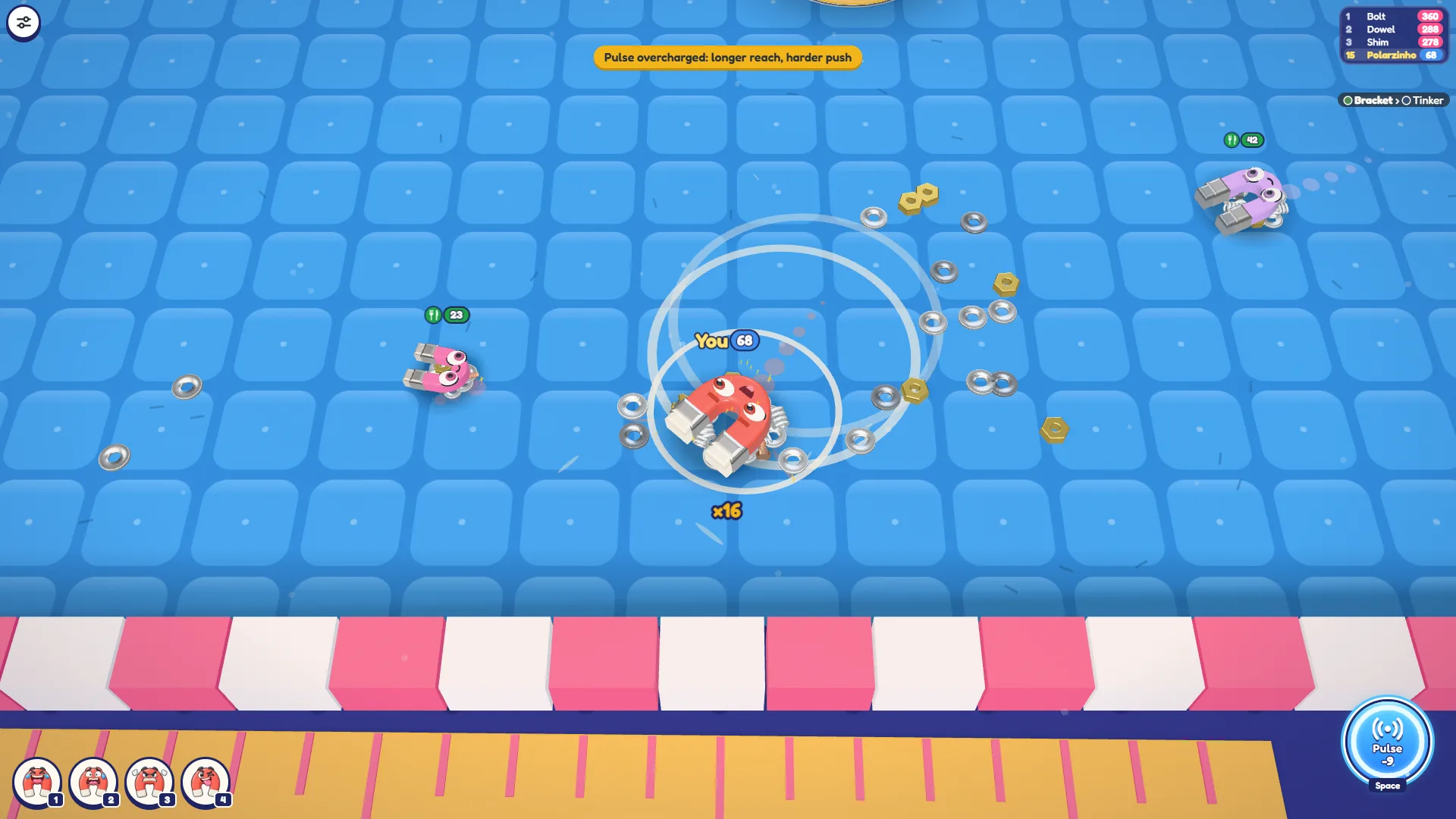
In Magnado I am a U-shaped magnet on a workshop tray, collecting nuts, bolts and washers. Every piece adds to my mass and makes my magnet stronger.

PolarzinhoNut, bolt, washer. All iron, all mine.
Just like real life, a bigger magnet pulls harder. When a much bigger rival gets close, the game warns you it is pulling you.

To push rivals away there is the pulse, which spends part of the metal you collected. My pocket-sized repulsion.
FAQ
What is a magnet?
An object that creates a magnetic field and attracts some metals, like iron.
Why do magnets stick to the fridge?
Because fridge doors are usually made of steel, which contains iron.
Are magnets attracted to aluminum?
No. Aluminum, copper, gold and silver do not stick to magnets.
What happens if you break a magnet?
Each piece becomes a new magnet with a north and a south pole.
Your turn
Grab a fridge magnet and test five things in your house: which ones stick? I bet some can will surprise you.