
LCM and GCF: What They Are and How to Find Them
What multiples and factors are, how to find the LCM and GCF (by listing and by prime factorization), how they relate, worked examples and what they are used for.
 By Polarzinho ·

Two little lights blink, one every 4 seconds and one every 6. When do they blink together again? That question is the LCM. And when I want to split bamboo into equal piles with none left over, the GCF helps.
Here you get what multiples and factors are, the two ways to find the LCM and GCF, how they relate and examples you can check in your head.
Multiples and factors
- Multiples of a number: the results of its times table. Multiples of 4: 4, 8, 12, 16, 20, 24...
- Factors of a number: the numbers that divide it with no remainder. Factors of 12: 1, 2, 3, 4, 6, 12.
What is the LCM?
The LCM is the least common multiple: the smallest number, greater than zero, that is a multiple of two or more numbers at the same time.
- Multiples of 4: 4, 8, 12, 16, 20, 24...
- Multiples of 6: 6, 12, 18, 24, 30, 36...
- The first one in both lists is 12. So LCM(4, 6) = 12.
Back to the lights: one blinks every 4 seconds and the other every 6, and they blink together every 12 seconds.
What is the GCF?
The GCF is the greatest common factor (also called the GCD, greatest common divisor): the largest number that divides two or more numbers at the same time.
- Factors of 12: 1, 2, 3, 4, 6, 12.
- Factors of 18: 1, 2, 3, 6, 9, 18.
- The common ones are 1, 2, 3 and 6. The largest is 6. So GCF(12, 18) = 6.
Using prime factorization
Break each number into primes: 12 = 2 × 2 × 3 and 18 = 2 × 3 × 3.
- LCM: multiply all the factors, taking each one with its highest power. 2² × 3² = 36.
- GCF: multiply only the shared factors, with the lowest power. 2 × 3 = 6.
How the LCM and GCF are related
For two numbers, LCM × GCF = the product of the numbers. Check: 36 × 6 = 216, and 12 × 18 = 216.
More examples
- GCF(48, 36) = 12 and LCM(48, 36) = 144.
- LCM(4, 6, 10) = 60.
- GCF(8, 20) = 4 and LCM(8, 20) = 40.
What they are used for
- LCM: adding fractions with different denominators. In 1/4 + 1/6, the LCM of the denominators is 12, so it becomes 3/12 + 2/12 = 5/12.
- LCM: finding when two repeating events line up again, like lights, buses or gears.
- GCF: simplifying fractions. In 12/18, the GCF is 6, and the fraction becomes 2/3.
- GCF: splitting into equal groups with nothing left over.
Waiting for the gap in Pinloop
In Pinloop, the ring spins and you wait for the right gap to stick your pin. It is a timing game: you follow a spin that repeats, a bit like the LCM of repeating events.

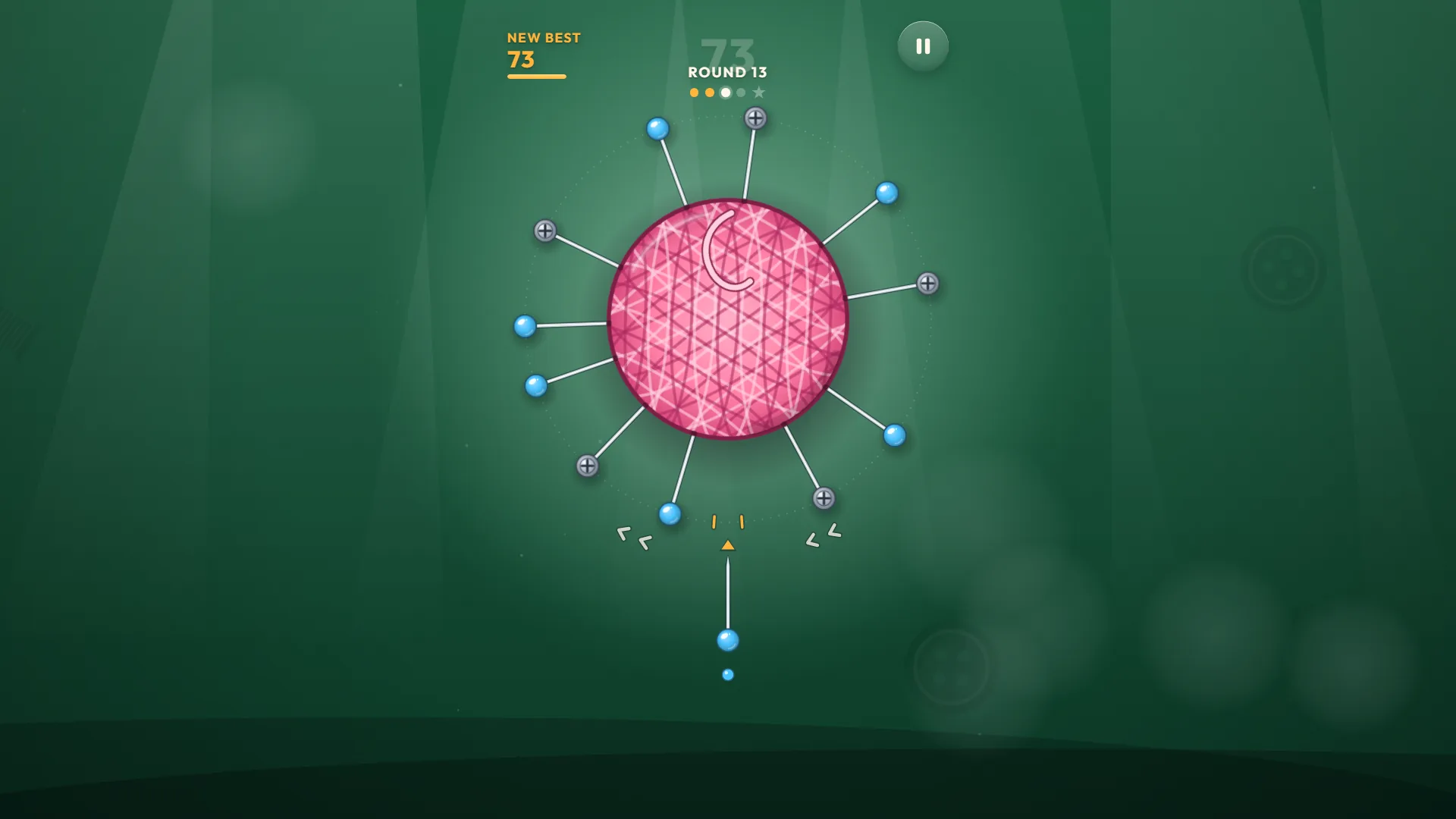
PolarzinhoWaiting for the gap is my personal LCM.
FAQ
What is the LCM?
The least common multiple: the smallest number, greater than zero, that is a multiple of all the given numbers.
What is the GCF?
The greatest common factor: the largest number that divides all the given numbers.
What is the LCM of 4 and 6?
12.
What is the GCF of 12 and 18?
6.
Your turn
Find the LCM and GCF of 8 and 20. Answers: LCM = 40 and GCF = 4. Check that LCM × GCF gives 160.