
How to play dominoes: rules for beginners
28 tiles, two open ends and a panda who thought the boneyard was a spooky place. Classic dominoes rules, step by step.
 By Polarzinho ·

Dominoes is one of those games everyone has seen at a family table or in a park, but few people can explain in one go. Every house has its own rules, and the arguing usually starts before the first tile is down.
I'm Polarzinho, the Polar Games panda, and I learned dominoes rules by playing Pip Club against Rico, Faísca and Nix. Here is classic double-six dominoes the way most people play it: the tiles, who goes first, how to match, when to draw, how to go out and how to score. At the end you get the best-known variations and a few tips so you lose less than I did.
The tiles: a double-six set
The most common set is double-six: 28 rectangular tiles, sometimes called bones, each split into two halves with 0 (blank) to 6 pips. Every combination appears exactly once, from 0-0 to 6-6.
Tiles with the same number on both halves, like 3-3 or 6-6, are doubles. There are seven of them, one per number. Each number shows up on eight halves across the whole set, which matters a lot once we get to strategy.
- 28 tiles in total.
- 7 doubles: 0-0, 1-1, 2-2, 3-3, 4-4, 5-5 and 6-6.
- Each number appears on 8 halves.
- All the pips in the set add up to 168.
How many dominoes each player draws
Before the game, all tiles go face down and get mixed on the table. Some people call it shuffling, some call it washing the bones.
With two players, each takes 7 tiles and the other 14 stay face down to the side. That spare pile is the boneyard. With four players, each takes 7 and the whole set is dealt, so there is no boneyard.
In Pip Club it is you against one computer opponent. Each of you gets 7 tiles, and a counter next to the Draw button shows how many are left in the boneyard.
Who goes first in dominoes
In the classic rule, the player with the highest double opens, usually the 6-6. If nobody has a double, the tile with the highest total opens. In many homes, the winner of the last round starts the next one.
Pip Club does it the classic way: the highest double opens. With no double, the highest total opens, and on a tie, the higher half decides.
How to match tiles: the two open ends
After the first tile, the line always has two open ends. On your turn you play a tile with the same number as one of the ends, touching the matching halves. A 4-2 goes on a 4 end or a 2 end. Blank matches blank.
Doubles are usually placed crosswise so everyone can see them. In classic block and draw games they don't open new branches and don't give an extra turn. They are just a tile with the same number on both halves.
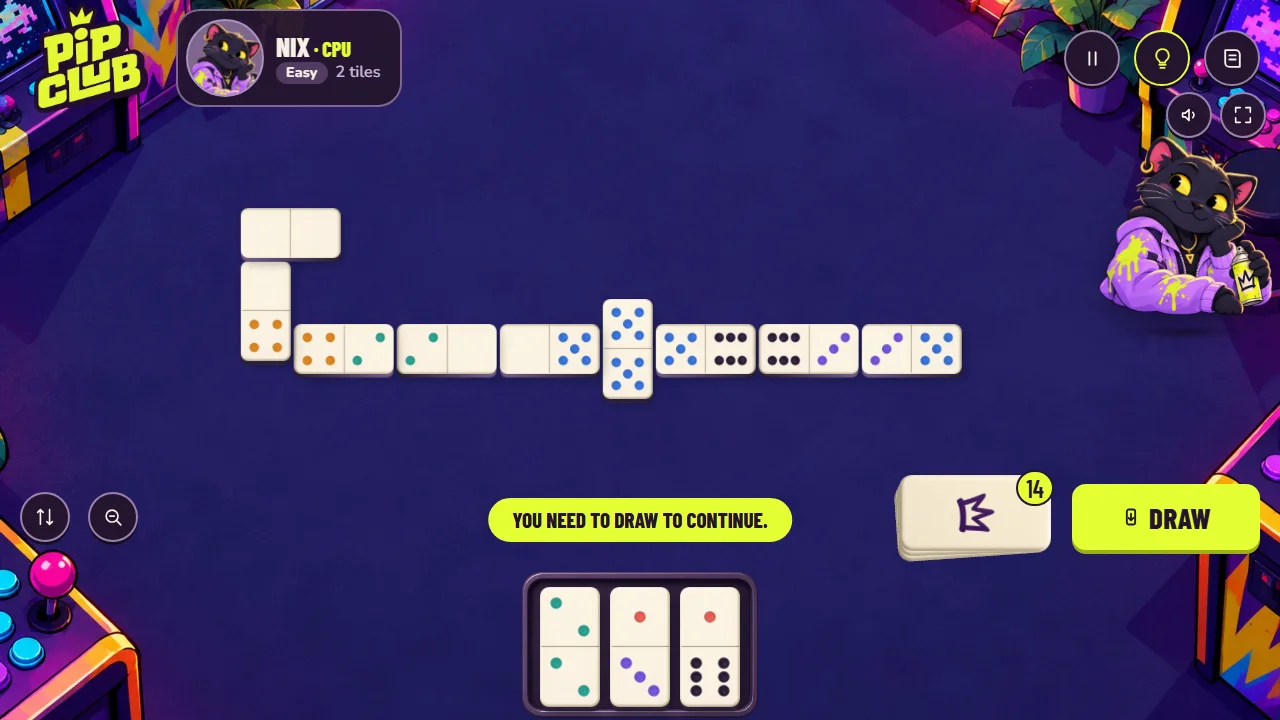
PolarzinhoLook at this. Nix has 2 tiles, I have 3, and none of mine fit. The game even tells me, very politely: you need to draw to continue. Thanks. I was pretending not to notice.
In Pip Club the tiles you can play glow, and the table shows where each one will land. If you're still learning how ends work, that preview helps a lot.
When to draw from the boneyard and when to pass
If none of your tiles match, you draw from the boneyard one tile at a time until you get one that fits, then play it. If the boneyard is empty and you still can't play, you pass.
At a four-player table there is no boneyard, so a player who can't match simply passes. That style, with no drawing, is the block game. The style with drawing is the draw game, and it's the one Pip Club plays.
How to domino and how scoring works
Going out, or dominoing, means playing your last tile. Whoever goes out wins the round. In the most common scoring, the winner gets the total pips left in the opponent's hand. If they're stuck with 6-4 and 2-1, you score 13.
A game can be a single round or several rounds up to a target score. Pip Club has a Quick Round, which is one round, and a Points Match played to 50 or 100.
- Someone plays their last tile and calls domino.
- The other players show the tiles left in their hands.
- Add up all the pips on those tiles.
- The total goes to the player who went out.
- Play the next round until someone reaches the target.
Blocked game: when nobody can play
Sometimes the ends show numbers nobody has and the boneyard is empty. Nobody can move, so the game is blocked, or locked. Everyone shows their hand and the lowest total wins.
In Pip Club the table locks after two passes in a row with an empty boneyard. The player with the lower total wins the difference between the two hands. Equal totals tie the round.

PolarzinhoI locked the table thinking I was a genius. I was a genius for Nix. He had fewer pips in hand, took +8 and then asked for a rematch with the smuggest cat face I've ever seen.
Popular dominoes variations
Rules change a lot from place to place, so agree on the version before you start. The ones you'll meet most often:
- Partnership dominoes: four players in two teams, partners sitting across. No boneyard, 7 tiles each.
- Draw dominoes: two or three players with a boneyard to draw from. This is what this guide covered.
- All fives (Muggins): you score during the round whenever the open ends add up to a multiple of 5.
- Mexican Train: every player builds a personal train from a central double, usually with a bigger double-twelve set.
Pip Club plays classic double-six draw dominoes, one against one. It has no partnership mode and no all-fives scoring, which makes it a good place to practise the basics before game night.
Dominoes strategy tips for beginners
- Play heavy tiles like 6-5 and 6-6 early. If the game blocks, they count against you.
- Don't hold only one number. A mixed hand saves you from drawing.
- Count tiles. If six halves of 4 are already on the table, only two are left in the whole set.
- Watch when your opponent draws or passes. They're telling you which number they lack.
- When you can, close the end your opponent needs and keep open the one you have plenty of.

PolarzinhoI started on Easy against Rico, won, got cocky and jumped to Hard against Nix. Don't skip levels. Going back to Easy is not shameful. I did it twice.
FAQ
How many tiles are in a set of dominoes?
A standard double-six set has 28 tiles, with 0 to 6 pips on each half.
How many dominoes does each player get?
Usually 7. With two players, 14 stay in the boneyard; with four players, the whole set is dealt.
Who goes first in dominoes?
The player with the highest double, usually the 6-6. With no doubles, the highest total opens.
What happens when a dominoes game is blocked?
Nobody can play. Everyone shows their tiles and the player with the fewest pips wins.
Can I play dominoes online for free?
Yes. Pip Club runs free in your browser on a computer or phone, against three computer opponents.
Ready for a round?
Pip Club is the Polar Games dominoes game: classic double-six on a rooftop at sunset, against Rico, Faísca and Nix. There's a Quick Round, a Points Match to 50 or 100 and a 9-encounter campaign across three hangouts to unlock.

PolarzinhoZero out of nine seals. For now. A patient panda gets there eventually.